
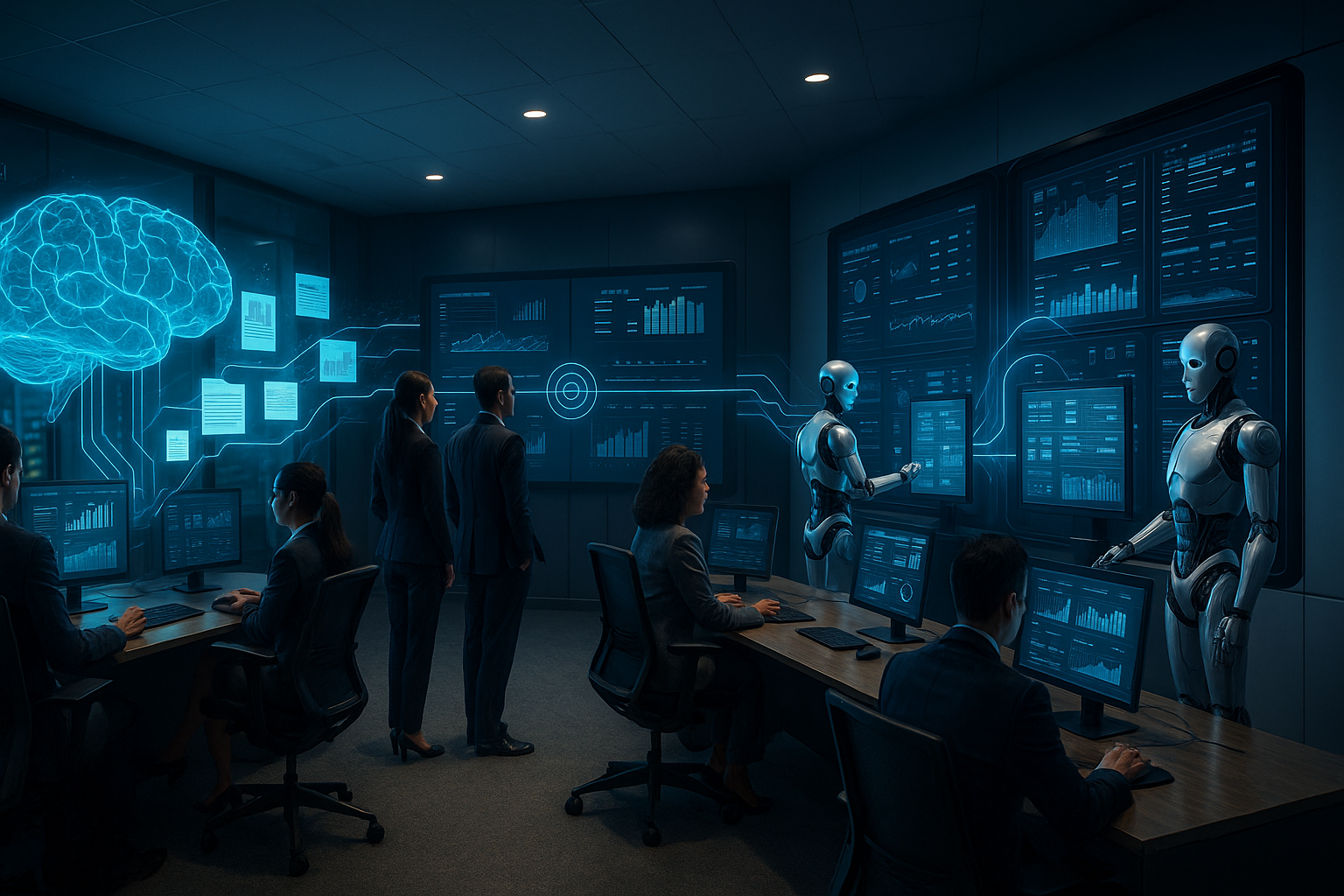
In the last decade, automation has shifted from being a cost-cutting afterthought to a core strategic driver for medium and large businesses. Two terms now dominate this conversation: Artificial Intelligence (AI) and Robotic Process Automation (RPA).
For decision-makers evaluating automation strategies, the landscape can be confusing. Many leaders ask: Is RPA part of AI? Is RPA considered AI? What’s the difference between RPA and AI? These are important questions because the answers directly influence how you design your automation stack, which skills you hire, and how you measure return on investment.
This article will clarify the relationship between AI and RPA, highlight their differences, and explain how combining the two can create a more powerful, scalable automation strategy.
Is RPA Part of AI? Clearing the Confusion
At first glance, RPA can seem “intelligent.” It automates tasks, interacts with systems, and mimics human actions. But the truth is, RPA is not AI.
- RPA is software designed to follow predefined rules. It’s a digital worker that clicks buttons, moves data between systems, and fills in forms exactly as it was instructed. It excels at repetitive, structured tasks and operates on structured data.
- AI, on the other hand, is built to learn and adapt. Using methods like machine learning, natural language processing, and computer vision, AI can make decisions in uncertain situations, adapt to new patterns, and work with unstructured data.
Think of it this way: RPA is like a pre-programmed robot on an assembly line it performs its task perfectly every time. AI is the skilled technician who can analyze a problem, identify a defect, and decide on the best course of action. When you combine them, you get an assembly line that can both execute tasks and make smart, real-time decisions.
Difference Between RPA and AI
The key difference between RPA and AI is in their core purpose and nature.
- RPA is rule-based and deterministic. It follows exact instructions and works only with structured data. It’s great at doing the same task over and over again with zero deviation.
- AI is adaptive and probabilistic. It can handle both structured and unstructured data, detect patterns, make predictions, and adjust its output based on feedback.
A finance department, for example, might use RPA to extract data from incoming invoices and upload it into an ERP system. This is a perfect task for RPA because it’s predictable and rule-based. However, if you add AI, the possibilities expand. AI could interpret invoices from multiple suppliers in different formats and languages, or identify anomalies in the data before it’s processed.
Robotic Process Automation Examples in the Enterprise
Robotic process automation has countless applications in medium and large businesses. For example, a finance department might use RPA to extract data from incoming invoices and upload it into an ERP system. A human resources team might use it to process payroll by pulling time-sheet data, calculating salaries, and generating pay slips. A supply chain team might use RPA to reconcile thousands of purchase orders against delivery records every night.
None of these tasks require reasoning or problem-solving they are repeatable, rule-based, and perfect for RPA.
When AI is added, the possibilities expand. AI could interpret invoices from multiple suppliers in different formats and languages. It could identify anomalies in payroll data before processing. It could predict supplier delivery delays based on historical performance and market signals. This is where AI and RPA together elevate automation from simple execution to intelligent, context-aware decision-making.
Is Robotic Process Automation AI? Why the Distinction Matters
It’s common for vendors to blur the lines, marketing RPA as “AI-powered” even when no AI is involved. This distinction matters because it affects budgeting, expectation-setting, and organizational change.
From a budgeting perspective, AI requires data science resources, training cycles, and model maintenance. From an expectations perspective, deploying RPA will not deliver predictive analytics or natural language understanding unless AI capabilities are added. From a change management perspective, AI adoption often requires more cultural adaptation than RPA, because it impacts decision-making processes rather than just task execution.
So is robotic process automation AI? Not in its pure form. But when integrated with AI, RPA becomes a foundation for more advanced intelligent process automation.
The AI and RPA Convergence: Intelligent Process Automation
When AI and RPA are used together, the approach is often called Intelligent Process Automation (IPA). In an IPA workflow, RPA bots handle the “doing,” while AI models handle the “thinking.”
Consider an order processing workflow:
- An email with a purchase order arrives.
- AI reads and interprets the document, extracting the necessary information.
- RPA then takes that extracted data and enters it into the ERP system, triggers a confirmation email, and updates the inventory database.
This process combines AI’s ability to understand and classify information with RPA’s ability to execute multiple system interactions instantly, creating a powerful, end-to-end automated workflow.
Why This Matters for Your Business
The combination of AI and RPA offers four key advantages for medium and large businesses.
- Scalability: An RPA bot can be replicated across multiple departments with minimal effort. AI models, while requiring more oversight, can also be scaled to handle larger data sets and more complex problems.
- Cost Efficiency: RPA can dramatically reduce operational costs by automating manual, repetitive work. AI extends this by automating decisions that previously required human judgment, unlocking even greater value.
- Risk Management: AI can be used to detect fraud or anomalies, while RPA ensures compliance by following exact process rules every time.
- Speed: RPA can often be deployed in weeks, delivering quick wins. AI capabilities can then be layered on as your organization’s data maturity grows, building a robust automation ecosystem.
The journey toward an autonomous enterprise where AI-driven decisions automatically trigger actions across multiple systems starts with building a solid AI and RPA foundation today.
Role of a Robotic Process Automation (RPA) Developer
A robotic process automation RPA developer plays a critical role in turning business needs into automated workflows. Their work includes mapping processes, building bots in platforms like UiPath, Blue Prism, or Automation Anywhere, integrating RPA bots with AI services, and monitoring performance.
In projects where AI is integrated, RPA developers often collaborate with data scientists to embed machine learning models into automated processes. This requires not only technical skills but also an understanding of the business rules and compliance requirements that govern each process.
Selecting an AI Automation Agency
If your organization does not have in-house expertise, partnering with an artificial intelligence automation agency or AI automation agency can significantly accelerate results. The right agency will not only deploy automation tools but will also help you re-engineer workflows for maximum impact.
Typical AI automation agency services include process discovery, feasibility analysis, RPA bot development, AI model training, systems integration, and ongoing monitoring. This is especially valuable in medium and large enterprises where automation often needs to work across multiple legacy systems and modern SaaS platforms.
An experienced partner will help you build an automation ecosystem that grows with your business, rather than a set of disconnected tools.
Building the Right AI Automation Stack
A modern AI and RPA stack usually includes three key layers. The first is the RPA platform, such as UiPath, Blue Prism, or Automation Anywhere, which executes tasks. The second is the AI and machine learning services layer, which may come from cloud providers like Azure, AWS, or Google Cloud. The third is the orchestration and integration layer, which connects everything and ensures workflows run smoothly.
Governance tools are also important to monitor compliance, security, and performance over time. This is where process mining and performance dashboards help decision-makers see where automation is delivering value and where improvements are needed.
Challenges in Adoption
While the benefits are clear, adopting AI and RPA isn’t without its challenges.
- Change resistance: Employees may fear that automation will replace their roles. Clear communication and upskilling programs are crucial to address this.
- Data quality: AI models require high-quality, well-labeled data to perform reliably. Without it, the output can be inconsistent.
- Vendor lock-in: Relying too heavily on a single platform can make it harder to adapt in the future.
Many businesses mitigate these risks by starting with pure RPA for quick, tangible wins, then gradually integrating AI capabilities as they gain experience and data readiness.
The Future: Autonomous Enterprises
As AI automation matures, we are moving toward autonomous enterprises organizations where AI-driven decisions automatically trigger actions across multiple systems without human intervention.
Imagine a supply chain that detects demand spikes, reorders materials, reroutes shipments, and adjusts pricing in real time, all without human input. For decision-makers, the journey to this level of automation starts with building a solid AI and RPA foundation today.
How Punctuations Can Help
Punctuations specializes in helping medium and large enterprises design and implement automation strategies that combine the strengths of AI and RPA. As an AI automation agency, we provide end-to-end services, from process discovery and RPA development to AI model integration and ongoing governance.
We focus on building automation ecosystems that not only reduce costs but also increase accuracy, improve decision-making, and enable scalability. Whether you are just beginning with RPA or ready to integrate advanced AI capabilities, our team can guide you through every stage.
If you are ready to explore how AI and RPA can transform your operations, get in touch with us today.
Let’s design an automation strategy that works for your business and delivers measurable results.