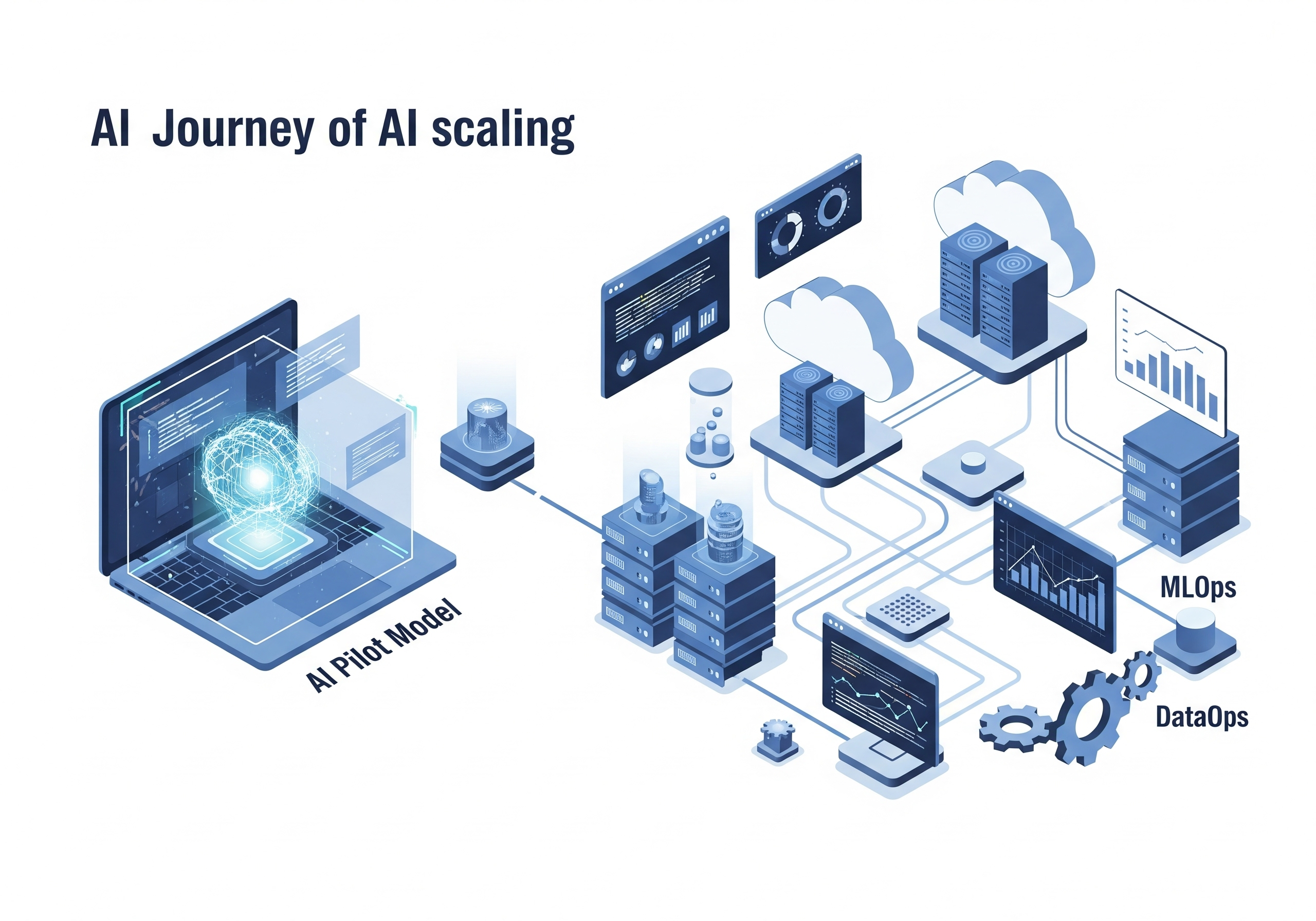
In the last two years, large language models (LLMs) have gone from a research novelty to boardroom talking points. Enterprises are experimenting with ChatGPT, Claude, LLaMA, and dozens of other foundation models to accelerate productivity, streamline knowledge management, and improve customer engagement.
But for organizations handling sensitive data banks, healthcare providers, pharmaceutical companies, manufacturers, government contractors the risks of sending data to external APIs or cloud-hosted AI services often outweigh the benefits. Concerns about compliance, intellectual property leakage, and data sovereignty make public LLMs a non-starter. That’s why more CIOs, CTOs, and CISOs are exploring “Private GPT” deployments: secure, on-premise large language models designed specifically for enterprise use. This post explores what it means to run a private LLM, the architecture behind such deployments, and the real business benefits of keeping AI close to home.
The Unseen Risks of Public LLMs
Before we dive into the architecture of a private LLM, it’s essential to understand the inherent vulnerabilities of their public counterparts. When your employees or applications interact with a public LLM via an API, the data they send the “prompt” is processed on the vendor’s servers. While these providers offer strong security measures, the very nature of their business model creates several risks for your enterprise:
- Data Leakage and Exposure: The most significant concern is that sensitive data, from intellectual property to personally identifiable information (PII), could be exposed to a third party. While most public LLM providers claim not to use customer data for training their models, the data still resides on their infrastructure, creating a potential vector for a breach. In industries like finance, healthcare, and law, this is an unacceptable risk.
- Lack of Data Sovereignty: Data residency laws, such as GDPR in Europe and similar regulations in other regions, mandate that certain types of data must be stored and processed within specific geographic borders. Using a global cloud service can make it difficult, if not impossible, to guarantee that your data never leaves a designated region, putting you in direct violation of these laws.
- Compliance and Auditing Challenges: For businesses in highly regulated sectors, robust compliance and auditing are non-negotiable. With a public LLM, you lack the granular control and visibility required to demonstrate to auditors that your data is being handled according to strict regulatory frameworks like HIPAA, PCI DSS, or SOC 2. The black-box nature of these services makes a transparent audit trail difficult to establish.
Model Hallucinations and Inaccuracy: Publicly trained models are general-purpose. They may lack the specific domain-knowledge required to provide accurate, reliable answers for your business. For instance, a public LLM can’t understand your proprietary internal policies, your specific product catalog, or your company’s unique legal terminology. This can lead to “hallucinations” where the model confidently fabricates incorrect information which is a major liability when accuracy is paramount.
Why “Private GPT” Matters
The appeal of consumer-facing AI assistants lies in their convenience. But behind the scenes, every prompt and interaction is typically processed on infrastructure outside your control. For an enterprise, that creates multiple red flags:
- Data confidentiality: Legal documents, patient records, or proprietary R&D notes cannot risk exposure to third-party servers.
- Compliance requirements: Industries bound by HIPAA, GDPR, SOC 2, or FedRAMP need auditable guarantees about where and how data is processed.
- Intellectual property (IP) protection: Feeding sensitive IP into a shared cloud model could expose trade secrets.
- Vendor lock-in: Relying on external APIs creates long-term risks around pricing, availability, and control.
A private, on-premise LLM addresses these challenges head-on. Instead of sending queries to a public service, the model is hosted within your own data center or a tightly controlled virtual private cloud (VPC). That means data never leaves your walls, and governance policies remain enforceable end-to-end.
The Case for an On-Premise Private LLM: A Paradigm Shift
Deploying an on-premise LLM fundamentally changes this dynamic, giving the enterprise complete control. A private LLM is a model that is hosted and managed within your own secure IT infrastructure, whether that’s in your physical data center or a dedicated private cloud instance. Here’s a look at the core benefits that make this a compelling choice for enterprise decision-makers.
- Uncompromising Security and Privacy: This is the cornerstone of the private LLM argument. Since your data never leaves your environment, it’s never exposed to a third party. You maintain full control over encryption, access controls, and network security. All data, from training to inference, remains behind your corporate firewall, eliminating the risk of accidental or malicious data leakage.
- Absolute Compliance and Data Sovereignty: With an on-premise deployment, you dictate where your data resides and how it’s handled. This ensures you meet even the most stringent data residency requirements and can easily demonstrate compliance to regulators. You have a full, transparent audit trail for all data and model interactions, providing peace of mind and simplifying the compliance process.
- Customization and Hyper-Relevance: A general-purpose model is only so useful. The true power of a private LLM lies in its ability to be fine-tuned on your organization’s unique, proprietary dataset. This is where your LLM becomes “Your Private GPT.” Imagine a model trained on all of your internal documents: your company’s knowledge base, legal contracts, project plans, and customer support transcripts. The result is a model that understands the nuances of your business, provides highly accurate and relevant responses, and becomes a truly valuable internal asset. This fine-tuning process can dramatically reduce hallucinations and produce outputs that are grounded in your reality.
- Cost Predictability and Performance Optimization: While an initial investment in hardware (typically high-performance GPUs) and expertise is required, the long-term cost model is often more predictable. You move away from variable, per-token billing of public APIs and can manage costs based on your own hardware utilization. Furthermore, by running the model on your own servers, you can optimize for latency and throughput, ensuring rapid response times for mission-critical applications.
The Architecture of a Private LLM
Building a private LLM isn’t about starting from scratch. That would be a massive, prohibitively expensive undertaking. Instead, it involves a strategic, multi-step process leveraging open-source foundation models.
- Model Selection: The journey begins with selecting a suitable open-source foundation model. Popular choices like LLaMA 3, Mistral, or Mixtral provide a robust, pre-trained base that can be customized. The choice often depends on the required model size, performance characteristics, and licensing terms.
- Infrastructure Provisioning: This is where the “on-premise” aspect comes to life. You need to provision a dedicated infrastructure stack, which typically includes:
- GPU Clusters: LLMs are compute-intensive. High-end GPUs from manufacturers like NVIDIA are essential for both the fine-tuning process and for serving the model for real-time inference.
- Secure Storage: A robust, encrypted storage solution to house your proprietary training data and the model weights.
- Orchestration: Tools like Kubernetes are used to manage and scale the deployment, ensuring high availability and efficient resource utilization.
- Data Preparation and Fine-Tuning: This is the most critical step. Your internal data from PDFs and internal wikis to email archives and customer logs—is cleaned, processed, and used to fine-tune the selected foundation model. The goal is to teach the model your company’s specific “language” and knowledge, tailoring its responses to your business needs.
- Deployment and Integration: Once fine-tuned, the model is deployed on your infrastructure. An API layer is built around it, allowing your internal applications to interact with the private LLM securely. This could be an internal-facing chatbot, an automated document summarizer, or a tool integrated directly into your CRM or ERP systems.
- Monitoring and Governance: Finally, a robust system for monitoring performance, ensuring security, and establishing an ongoing governance framework is essential. This includes tracking model accuracy, logging usage for auditing, and setting up safeguards to prevent misuse or bias.
Key Benefits of Going Private
Enterprises investing in on-premise or VPC-hosted LLMs aren’t just buying peace of mind. They’re unlocking tangible business value in areas where security and sovereignty are non-negotiable.
1. Data Sovereignty
Your data never leaves your environment. For multinational firms, this is crucial in regions with strict data localization laws (e.g., EU’s GDPR, India’s DPDP Act).
2. Compliance Readiness
Private GPTs can be configured to align with HIPAA, PCI-DSS, ISO 27001, and other compliance frameworks. Logs, access controls, and encryption provide auditable trails.
3. Intellectual Property Security
R&D-heavy sectors biotech, aerospace, defense can safely use AI to summarize, analyze, and generate insights without risking leakage of proprietary IP.
4. Tailored Performance
Unlike one-size-fits-all APIs, private deployments can be fine-tuned on domain-specific data. Imagine a legal LLM trained on decades of case law or a pharma LLM tuned to clinical trial reports.
5. Cost Predictability
While initial setup requires capital investment in hardware and expertise, long-term usage costs can be lower than API calls at scale. Predictable infrastructure costs replace fluctuating per-token billing.
6. Strategic Independence
Running your own model reduces dependency on external providers whose pricing, availability, or policies might shift. It gives your enterprise long-term control.
Real-World Use Cases
Financial Services
A private LLM can power secure chatbots for wealth advisors, summarize regulatory filings, or generate compliance reports without any data leaving the bank’s firewalled environment.
Healthcare
Hospitals can deploy models that assist with patient documentation, clinical decision support, and medical coding while ensuring HIPAA compliance.
Manufacturing & Supply Chain
Global manufacturers can analyze maintenance logs, automate supplier communication, and streamline documentation in multiple languages without exposing trade secrets.
Government & Defence
Agencies can process intelligence reports or citizen service queries with air-gapped LLMs that meet national security standards.
Challenges to Consider
Running your own GPT isn’t plug-and-play. CIOs and CTOs should weigh:
- Hardware Requirements: High-performing LLMs need GPUs, TPUs, or specialized accelerators. Smaller models can run on CPUs, but latency suffers.
- Ongoing Optimization: Models must be periodically updated, patched, and tuned for evolving use cases.
- Talent & Expertise: Hosting LLMs demands expertise in ML engineering, DevOps, and cybersecurity.
- Cost Trade-offs: While API costs vanish, infrastructure, electricity, and maintenance introduce new expenses.
The good news? The ecosystem is maturing rapidly. Tooling for inference optimization, vector search, and orchestration is more enterprise-ready than ever.
The Future of Enterprise LLMs
We’re at an inflection point. Just as early enterprise adoption of cloud computing required a “private cloud” bridge before full public cloud adoption, AI is likely to follow a hybrid trajectory.
In the near term, many enterprises will embrace Private GPTs for sensitive workloads and pair them with external APIs for less critical tasks. Over time, advances in confidential computing and federated learning may blur these lines.
But for now, enterprises that want to harness AI while protecting data sovereignty have a clear path: bring the LLM in-house.
Making AI Secure and Practical
Large language models are too powerful to ignore but too risky to outsource blindly when sensitive data is at stake. A secure, private deployment gives enterprises the best of both worlds: the intelligence of modern AI with the governance, compliance, and sovereignty they require.
At Punctuations, we specialize in helping enterprises design and deploy Private GPT architectures tailored to their industry, compliance needs, and scale. From model selection and fine-tuning to infrastructure design and integration with internal systems, we ensure your AI is not only cutting-edge but also secure, compliant, and business-ready.If your organization is exploring secure AI, now is the time to act. Let’s talk about how we can build your Private GPT on-premise, compliant, and fully yours.