The business world is no stranger to waves of technological disruption. From steam engines to electricity to computers, each shift has redefined how work gets done. Today, artificial intelligence (AI) represents the next great inflection point, one that will fundamentally reshape automation and the future of work.
For medium and large enterprises, the stakes are clear: those who adapt quickly will unlock new levels of efficiency, agility, and innovation. Those who hesitate risk falling behind in markets that are moving faster and becoming increasingly digital.
In this article, we’ll examine the impact of AI on automation, how it is altering workforce structures, and the opportunities and challenges it creates for business leaders.
Automation Before AI: A Brief Context
Automation has existed for decades. Manufacturing lines, robotic process automation (RPA), and enterprise workflows have long removed repetitive tasks from human hands. However, traditional automation had a significant limitation: it worked only with predefined, rule-based processes.
If a scenario changed outside of its script, the system broke down. This rigidity meant automation was best suited for highly structured environments but struggled with unstructured data, decision-making, or human-like reasoning.
AI changes this paradigm. With advancements in machine learning (ML), natural language processing (NLP), and generative AI, businesses can now automate tasks that require judgment, adaptation, and context-awareness.
How AI Transforms Automation
1. From Rules to Intelligence
AI enables automation to move from deterministic, rule-based execution to probabilistic, intelligent decision-making. Instead of “if X, then Y,” AI systems can evaluate complex variables, learn from patterns, and adapt dynamically.For example, customer service chatbots powered by NLP don’t just follow a script they can understand intent, handle variations in language, and escalate issues when necessary.
2. Handling Unstructured Data
Historically, unstructured data (emails, contracts, images, videos) was a blind spot for automation. With AI models capable of interpreting language, vision, and speech, companies can now process unstructured inputs at scale.Legal departments, for instance, can use AI to review contracts for risk patterns, while finance teams can automate invoice processing directly from scanned documents.
3. Predictive and Prescriptive Capabilities
Automation used to be reactive executing tasks as defined. AI introduces predictive capabilities, allowing systems to anticipate problems before they occur.For example, predictive maintenance in manufacturing uses AI to analyze sensor data and detect potential equipment failures, reducing downtime and saving millions annually.
4. Generative AI in Workflow Automation
Generative AI takes automation a step further by not only analysing information but creating new content. Marketing teams can auto-generate personalized ad copy for thousands of audience segments. HR can auto-draft job descriptions based on role profiles. This ability to “create” expands automation into domains previously seen as purely human.
The Future of Work: Key Shifts Driven by AI
1. Reallocation of Human Capital
As AI automates routine tasks, human effort shifts toward higher-value work strategy, creativity, relationship-building, and complex problem-solving. A finance analyst once consumed by reconciliations can now focus on forecasting and strategic modelling. A customer support agent can concentrate on resolving nuanced cases while AI handles FAQs.
2. Rise of Human-AI Collaboration
The future isn’t about humans being replaced it’s about humans and AI working together. We’re entering an era of “cobots” (collaborative robots) in factories, AI co-pilots for developers, and decision-support systems for executives. Decision-makers should think in terms of augmentation, not substitution: how can AI elevate employee productivity rather than eliminate roles entirely?
3. New Job Roles and Skills
With AI integration, entirely new categories of jobs are emerging:
- AI Trainers & Prompt Engineers – refining how models interact with data.
- AI Ethicists & Governance Experts – ensuring responsible use of algorithms.
- Data Annotators & Curators – preparing high-quality datasets.
Meanwhile, skills like data literacy, critical thinking, and adaptability are becoming as essential as technical know-how.
4. Flexible, Adaptive Organizations
AI-driven automation allows organizations to become more agile. Processes can adjust in real-time based on demand, market conditions, or operational constraints. For example, supply chain systems can reroute logistics instantly when disruptions occur. Sales forecasting models can update daily as new signals emerge. This adaptability reduces business risk in volatile environments.
Strategic Opportunities for Enterprises
For medium and large businesses, the integration of AI into automation unlocks transformative opportunities:
- Operational Efficiency – Streamlining workflows reduces costs and increases throughput.
- Scalable Personalization – Marketing, HR, and customer experience functions can deliver individualized services at scale.
- Faster Decision-Making – AI-powered analytics provide executives with real-time insights, replacing lagging reports with dynamic dashboards.
- Competitive Differentiation – Early adopters of AI-driven automation gain market share by innovating faster than competitors.
Challenges Business Leaders Must Address
While the potential is enormous, decision-makers must navigate several challenges to ensure successful adoption.
1. Data Quality and Governance
AI systems are only as good as the data they learn from. Poor data quality leads to poor decisions. Enterprises must invest in robust data pipelines, governance frameworks, and compliance mechanisms.
2. Workforce Transition
Automating tasks inevitably triggers concerns around job displacement. Leaders need clear change management strategies: reskilling initiatives, open communication, and a focus on workforce augmentation rather than replacement.
3. Integration with Legacy Systems
Most enterprises don’t start with a clean slate. Integrating AI automation into existing ERP, CRM, and operational systems requires technical and organizational alignment. A piecemeal approach often results in silos and underutilization.
4. Ethics, Bias, and Trust
AI models can reflect biases in training data. Enterprises risk reputational and regulatory consequences if these issues go unchecked. Transparent AI governance, bias audits, and explain ability frameworks must be integral to deployment.
Practical Steps for Decision-Makers
For executives and leaders considering AI-driven automation, a structured approach helps minimize risk while maximizing value:
- Identify High-ROI Use Cases – Start with repetitive, high-volume processes that directly impact efficiency or revenue.
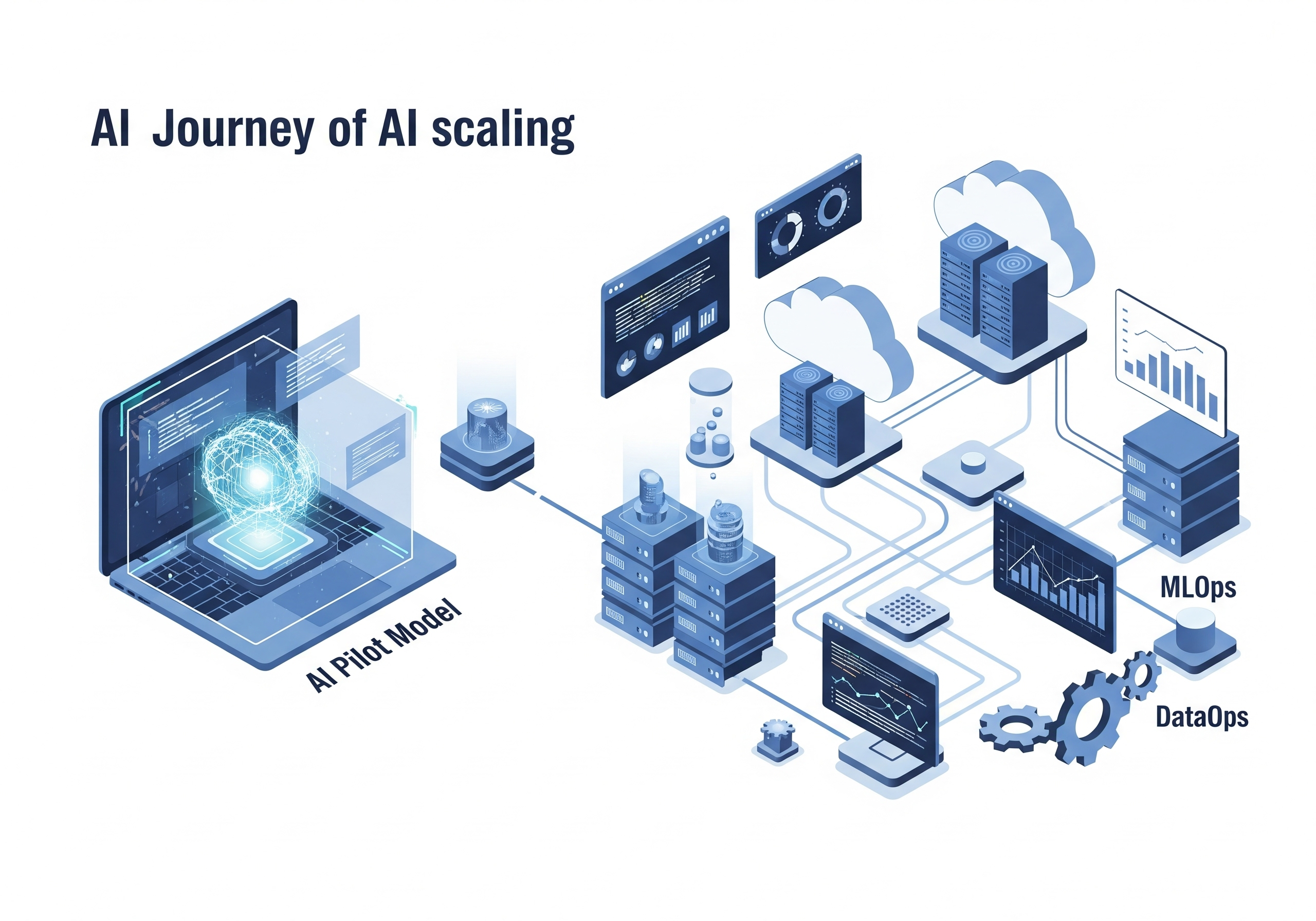
- Pilot Small, Scale Fast – Test AI automation in a controlled environment, measure ROI, then scale across departments.
- Invest in Infrastructure – Ensure you have scalable cloud, data, and security architecture to support AI workloads.
- Upskill Teams – Provide training for staff to work effectively with AI systems and transition into higher-value roles.
- Establish Governance – Build cross-functional committees to oversee AI ethics, compliance, and long-term strategy.
What the Next Decade Could Look Like
By 2035, enterprises that fully embrace AI-driven automation could see productivity gains equivalent to adding an entire additional workforce. Processes will increasingly run autonomously, with humans steering outcomes rather than executing steps.
In this future, businesses won’t ask, “Should we use AI for automation?” but rather, “How deeply can AI shape every facet of our work?”
Organizations that act now will build a durable competitive advantage, while laggards may find themselves outpaced by nimbler competitors who’ve redefined productivity through intelligent automation.
How Punctuations Can Help
At Punctuations, we understand that AI adoption isn’t just about deploying technology, it’s about reshaping business processes, culture, and outcomes. We help medium and large enterprises identify the right AI-driven automation opportunities, implement them with robust data governance, and ensure your teams are equipped for the transition.
Whether you’re looking to optimize internal workflows, build AI co-pilots for your employees, or develop secure AI systems tailored to your data, we bring the technical expertise and business understanding needed to deliver measurable results. If you’re ready to explore the future of work through AI-driven automation, let’s start the conversation. Get in touch with us today.