In recent years, enterprises have invested heavily in artificial intelligence (AI) and automation. Yet, despite deploying chatbots, predictive models, and robotic process automation (RPA), most businesses still face a familiar challenge: siloed solutions that handle tasks in isolation but fail to transform end-to-end workflows. The result is partial automation improvements in efficiency, yes, but rarely the leap toward an autonomous enterprise.
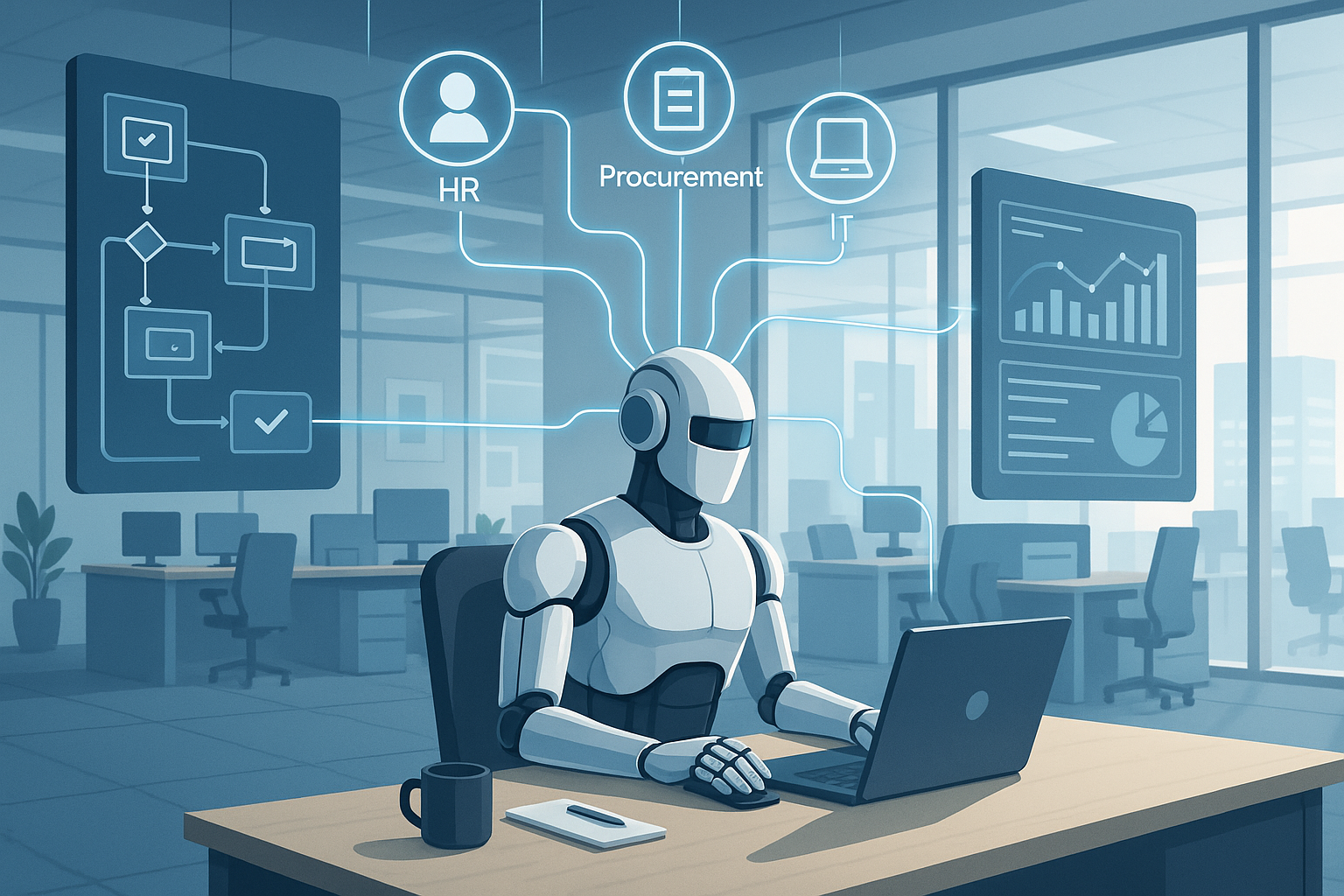
That leap requires something new: the agentic workflow. This approach is powered by AI agent architecture, a system where multiple specialized AI agents collaborate in a sequence, each responsible for a well-defined role, and together they automate entire business processes. Think of it as moving beyond individual tools toward a coordinated digital workforce. For decision makers in medium and large businesses, understanding this model isn’t just about staying current it’s about future-proofing operations in a market where speed, precision, and adaptability define competitiveness.
What Is an Agentic Workflow?
An agentic workflow is a structured process where different AI agents, each with unique skills, communicate and collaborate to complete a business task from start to finish.
- Agents are autonomous software entities powered by large language models (LLMs), APIs, and domain-specific logic.
- Workflow means these agents aren’t operating in isolation. They orchestrate passing context, triggering actions, and adapting to real-time changes just like teams in a business unit.
For example:
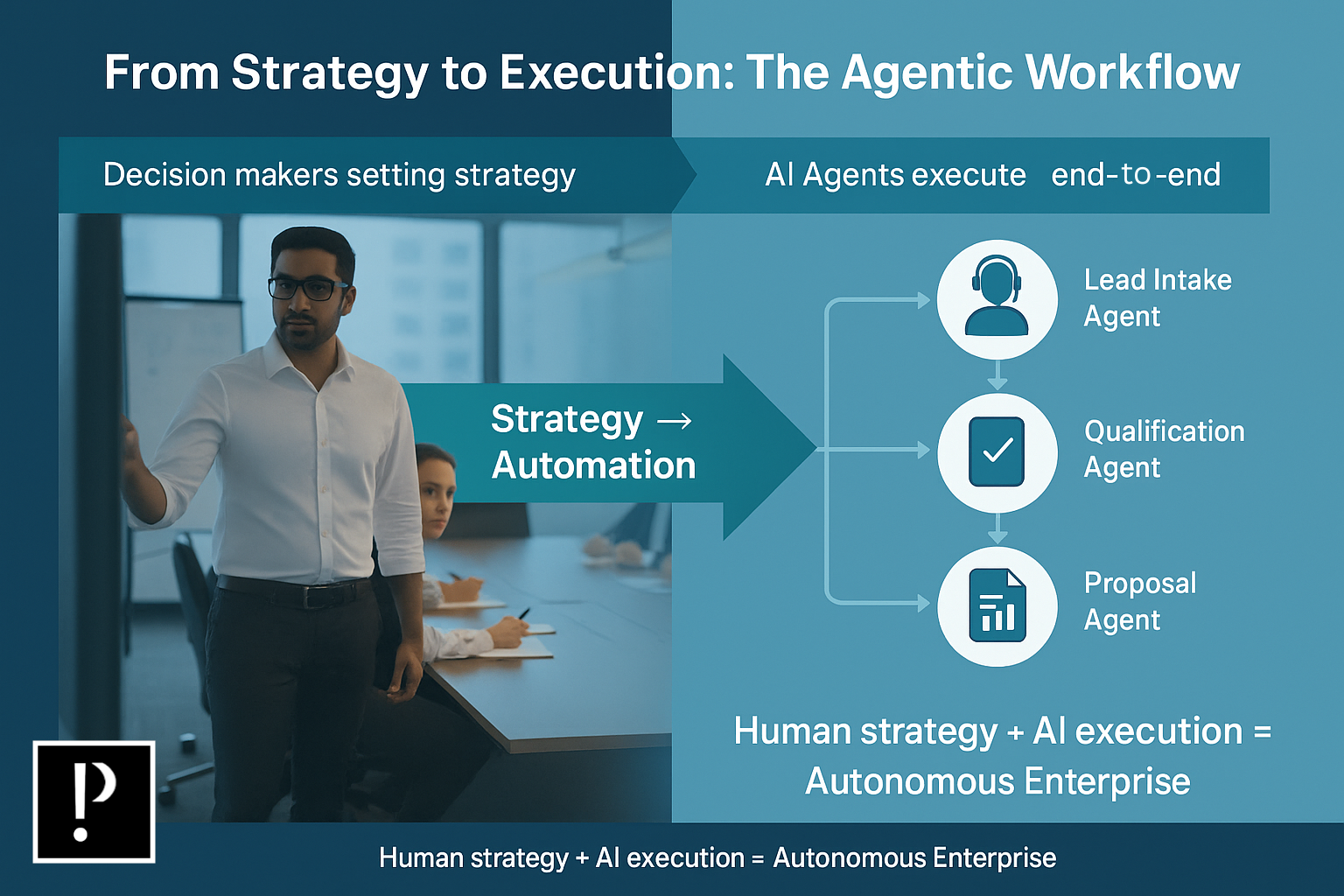
- A Lead Intake Agent captures data from inbound emails, chats, or web forms.
- A Qualification Agent cross-references CRM data and validates intent.
- A Proposal Agent drafts tailored sales proposals.
- A Reporting Agent generates dashboards and summaries for leadership.
Individually, none of these agents replace an entire department. But together, in sequence, they can automate an entire pipeline from first touchpoint to executive visibility.
Why Enterprises Need Agentic Workflows
Most automation projects today struggle with one of three issues:
- Fragmentation: A chatbot handles customer questions, but it doesn’t update your CRM. Your RPA script processes invoices, but it doesn’t communicate exceptions to finance.
- Human Handoffs: Systems stop short of decision-making. Employees still need to “stitch” tasks together, consuming time and creating errors.
- Scalability Limits: Point solutions don’t scale beyond their narrow use case, leaving leaders juggling dozens of disconnected tools.
An agentic workflow addresses these by:
- Orchestration: Agents share context and align toward a common outcome.
- Autonomy with oversight: Agents can make micro-decisions but escalate exceptions.
- Scalable modularity: New agents can be added to the workflow without re-engineering the entire system.
This makes the agentic workflow not just a technology upgrade but a strategic operating model.
The Architecture of Autonomy: How AI Agents Collaborate
So, what does the technical architecture of such a system look like? It’s less about a monolithic piece of software and more about a network of interconnected, purpose-built agents. Each agent is designed with a specific persona and toolset, allowing it to excel at its designated role.
A typical AI agent architecture includes:
- The Planner: This is the conductor of the orchestra. A high-level, sophisticated AI that takes the initial human prompt and breaks it down into a series of smaller, actionable sub-tasks. It maps out the entire workflow, determining which agents are needed and in what order.
- Specialized Agents: These are the workers. Each one has a specific “job” and is fine-tuned for a particular task. They’re often given a “persona” to help them reason and act appropriately. For example, a “Lead Intake Agent” is designed to interact with new prospects, ask clarifying questions, and categorize their needs. A “CRM Agent” is built with the specific knowledge and tools to update a CRM database.
- Tooling and APIs: Agents don’t just “think”; they “do.” They are connected to an arsenal of tools and APIs that allow them to perform real-world actions. This could be anything from calling a specific API to update a database, to sending an email, to generating an image, or searching the web.
- Memory and State: To maintain context, agents need both short-term memory (for the current task) and long-term memory (for knowledge acquired over time, like company policies or past customer interactions). This allows them to learn and improve over successive workflows.
- Validation and Self-Correction: A critical component. Agents must be able to validate their own work and, when a task fails or an error is detected, autonomously correct the issue or escalate it to a human. This self-correcting loop is what makes the system truly “autonomous.”
By dividing complex problems into manageable sub-tasks and assigning them to specialized agents, the system achieves a level of accuracy and efficiency that a single, general-purpose AI simply cannot.
The Benefits of Going Agentic
- Speed and Efficiency
Processes that once required days of coordination happen near-instantly. - Consistency and Compliance
Agents follow defined rules without fatigue or bias reducing compliance risk. - Scalable Capacity
Agents don’t need onboarding or training ramp-up. Scaling a process simply means adding more compute or spinning up additional agent instances. - Cost Transformation
It’s not just about lowering headcount. It’s about redirecting skilled talent to strategic work instead of repetitive tasks. - Future-Proofing
As your enterprise evolves, new agents can be slotted into existing workflows supporting new products, markets, or compliance regimes.
Challenges and Considerations
No enterprise transformation is without obstacles. Key challenges include:
- Integration Complexity: Agents need access to CRMs, ERPs, and legacy systems. APIs and middleware play a critical role.
- Data Quality: Garbage in, garbage out still applies. Poor data leads to poor agentic performance.
- Change Management: Employees may resist, fearing replacement. Communication should emphasize augmentation, not elimination.
- Security Risks: Agents that can take autonomous actions must be sandboxed, monitored, and controlled.
Forward-looking leaders treat these not as blockers but as design considerations building governance, data strategy, and training into the deployment plan.
Agentic Workflows vs. Traditional Automation
| Feature | RPA / Scripts | AI Agentic Workflow |
| Scope | Narrow, repetitive tasks | End-to-end processes |
| Adaptability | Fragile, breaks with change | Flexible, learns and adapts |
| Decision-making | Rule-based only | Context-aware, LLM-powered |
| Scalability | Complex to extend | Modular, agent add-ons |
| Business Impact | Efficiency gains | Strategic transformation |
This comparison highlights why agentic workflows are being called “the next evolution of enterprise automation.”
Industries Poised to Benefit
- Financial Services
- KYC (Know Your Customer) onboarding
- Loan application processing
- Compliance reporting
- Healthcare
- Patient intake and insurance verification
- Medical coding and billing
- Regulatory reporting
- Manufacturing
- Supply chain coordination
- Quality control reporting
- Inventory forecasting
- Professional Services
- Proposal and contract drafting
- Client reporting
- Knowledge management
Across industries, the same principle applies: replace siloed automation with coordinated agentic workflows.
Steps to Get Started
For decision makers considering the leap, here’s a roadmap:
- Identify Candidate Processes
Look for multi-step, cross-department workflows with high manual effort and repetitive patterns. - Define Agent Roles
Break the process into specialized agent tasks (e.g., intake, validation, enrichment, reporting). - Select an Orchestration Framework
Decide on the middleware or platform to coordinate agents. - Pilot in a Controlled Environment
Start small, with oversight. Prove ROI before scaling. - Establish Governance
Implement monitoring, audit logs, and human-in-the-loop checkpoints. - Scale Gradually
Add agents or extend workflows once the pilot proves successful.
Your First Step Toward an Autonomous Enterprise
The agentic workflow is not science fiction. It is the pragmatic next step for enterprises seeking to transform from fragmented automation to autonomous operations. By orchestrating specialized AI agents into coordinated workflows, businesses can accelerate processes, reduce errors, and unlock strategic capacity.
Medium and large enterprises that start today will gain a competitive advantage tomorrow moving beyond tactical efficiency gains toward truly autonomous enterprises.
How Punctuations Can Help
At Punctuations, we specialize in building and deploying enterprise-ready agentic workflows. Our expertise spans:
- Designing AI agent architectures tailored to your business processes.
- Integrating with existing systems (CRM, ERP, data warehouses) securely.
- Implementing governance and compliance frameworks to ensure safe adoption.
- Running pilot programs that deliver measurable ROI within weeks.
If your organization is ready to explore the next step toward an autonomous enterprise, our team can help you design, implement, and scale agentic workflows that deliver both immediate efficiency and long-term transformation.
Get in touch with us today and let’s start building the foundation for your autonomous enterprise.