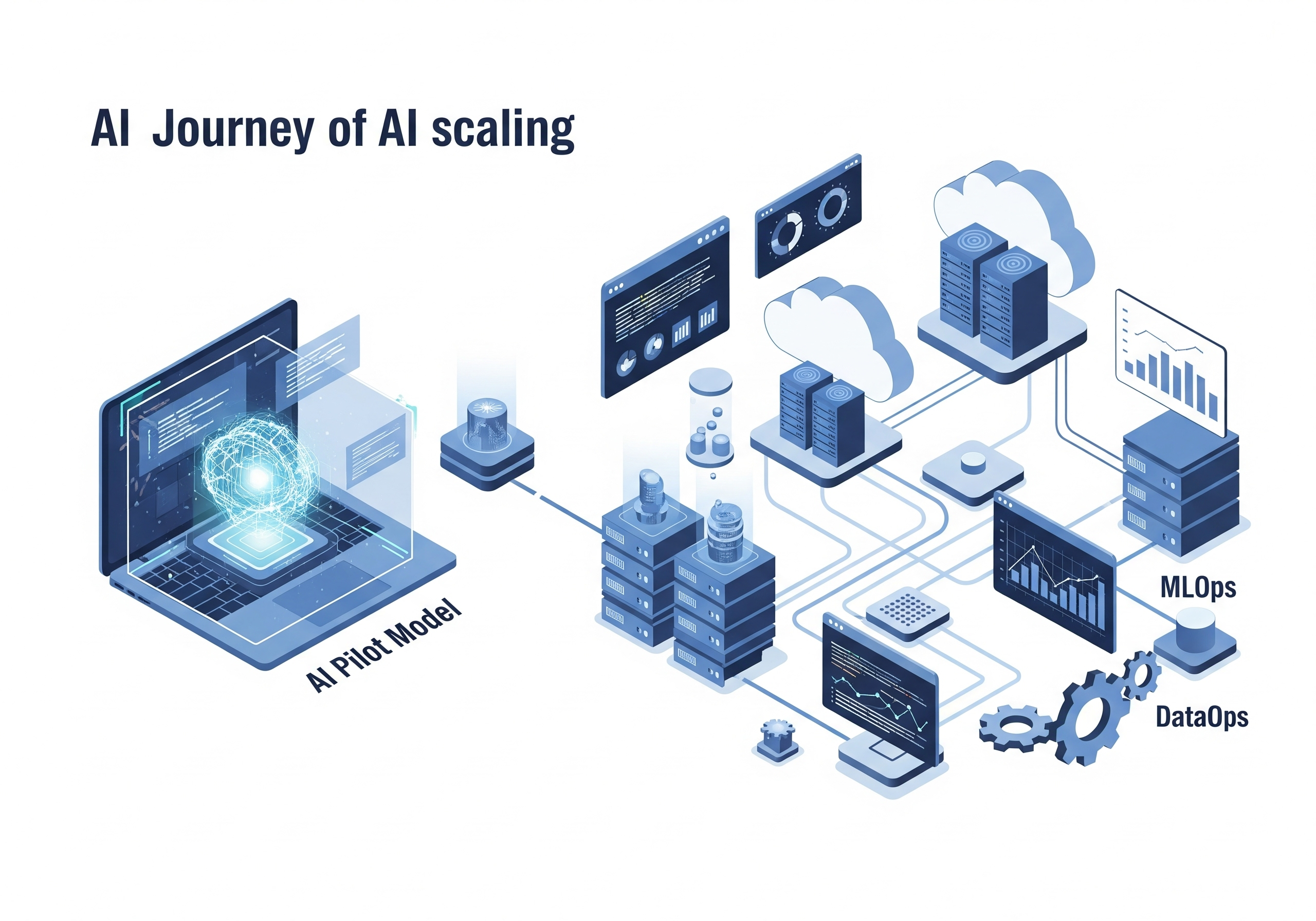
The biggest challenge is not building a demo, it’s deploying AI that works daily in a live environment. This single sentence encapsulates the chasm between a flashy proof-of-concept and a truly transformative business asset. For every successful AI pilot that dazzles a boardroom, countless others wither and die on the vine, unable to make the leap to production. For business leaders, this isn’t just a technical problem; it’s a strategic one that risks wasting significant investment and eroding trust in the very concept of enterprise AI.
The allure of the pilot is powerful. A small team, often unburdened by the complexities of enterprise IT, uses a clean, curated dataset to build a model that performs with remarkable accuracy. They can quickly demonstrate a compelling use case: a model that predicts customer churn with 90% accuracy, automates a document-processing workflow, or optimizes a supply chain with near-perfect precision. The pilot is a success, and everyone is excited. The problem, however, is that this success is often built on a fragile foundation one that cracks the moment you try to scale it.
The Pilot Trap: Why Your Demos Don’t Scale
Pilots are, by their very nature, idealized. They operate in a controlled environment, a sort of “laboratory” for algorithms. The data used is often historical and meticulously cleaned. The model is static, trained once and evaluated on a well-behaved test set. But the real world is messy. The moment you introduce an AI pilot to a live environment, it collides head-on with a host of complex, unpredictable variables.
Consider data drift, the silent killer of production AI. Your model, trained on past customer data, assumes certain patterns and behaviors. But customer tastes change, market conditions shift, and new competitors emerge. The distribution of your live data begins to drift away from the data your model was trained on, and its performance degrades imperceptibly but inevitably. A pilot has no answer for this. A production system, however, must be engineered to detect and respond to it, automatically retraining or alerting an engineer.
Similarly, pilots often bypass critical enterprise requirements like security, latency, and integration. A demo can take minutes to process a request; a live system for fraud detection needs to respond in milliseconds. A pilot might sit on a lone laptop or a single cloud instance, but a production system needs to be robust, secure, and integrated seamlessly into a company’s existing software architecture. This isn’t just about API calls; it’s about authentication, data governance, and ensuring the AI can “talk” to legacy systems without breaking them.
The transition from a pilot to a production system is not a continuous line; it’s a quantum leap. The difference isn’t just in the number of users or the amount of data. It’s a fundamental shift in mindset, from building a single, isolated artifact to engineering a durable, scalable, and manageable system.
The Unseen Iceberg: The Core Challenges of Production AI
When an AI pilot fails to scale, the root causes are almost always found in the unseen infrastructure below the waterline. This “iceberg” of challenges can be categorized into three critical areas: DataOps, MLOps, and System Integration.
1. DataOps: The Lifeblood of AI
You’ve heard that data is the new oil. Well, DataOps is the pipeline, the refinery, and the distribution network that makes that oil useful. A production AI model is only as good as the data it consumes, and in a live environment, that data is in constant flux. DataOps encompasses the entire lifecycle of data for machine learning: from collection and cleaning to validation, monitoring, and versioning.
- Data Pipelines: A pilot might manually ingest a CSV file. A production system requires automated, fault-tolerant data pipelines that continuously feed the model with fresh, validated data.
- Data Quality & Governance: What happens when a sensor on the factory floor malfunctions and starts sending nonsensical data? A production system needs robust data validation checks to prevent “garbage in, garbage out.” This also extends to data governance ensuring data is used responsibly and in compliance with regulations like GDPR.
- Feature Stores: In a large organization, multiple teams might need to use the same features (e.g., customer lifetime value, historical purchase history). A feature store acts as a centralized, versioned repository for these features, ensuring consistency and preventing redundant work.
2. MLOps: The DevOps for Machine Learning
If DataOps handles the data, MLOps handles the model. This discipline is the convergence of Machine Learning, DevOps, and Data Engineering. It provides the essential scaffolding to take a static model from a Jupyter notebook to a dynamic, living service.
- Automated Pipelines: Just as software engineers use CI/CD (Continuous Integration/Continuous Deployment) to automate code releases, MLOps pipelines automate the training, testing, and deployment of machine learning models. This ensures reproducibility and consistency, and enables rapid iteration.
- Model Versioning and Registry: As models are retrained and improved, a production system needs to manage different versions. A model registry acts as a central hub to store, manage, and track these models, along with their metadata and performance metrics.
- Model Monitoring: This is perhaps the most critical component. A deployed model isn’t a “fire and forget” asset. It must be constantly monitored for performance degradation (model drift) and data drift. When a model’s performance falls below a certain threshold, the monitoring system should automatically trigger an alert or, in advanced setups, kick off a new retraining cycle.
3. System Integration & Scalability
A successful AI model is useless if it exists in a vacuum. It must be seamlessly integrated into your existing business processes and technology stack. This is where the discipline of software engineering meets data science.
- Microservices Architecture: Modern production systems are often built as a collection of independent, interoperable microservices. This modular approach allows the AI model to be deployed as its own service, accessible via a well-defined API.
- Containerization & Orchestration: Technologies like Docker and Kubernetes are no longer just for software engineers; they are essential for AI. They allow you to package your model and its dependencies into a consistent, portable container that can be deployed on any infrastructure, from a cloud to an on-premise server. Kubernetes, in particular, handles the orchestration, ensuring the model can scale horizontally to handle millions of requests and remain highly available.
Why Scaling AI Is So Hard for Enterprises
Medium and large enterprises face unique hurdles that startups and smaller teams don’t:
- Legacy systems: Integrating AI into decades-old ERP or CRM stacks can be more complex than training the model itself.
- Siloed data: Different business units often guard their data, making unified pipelines difficult.
- Procurement & compliance processes: Lengthy vendor approvals and security reviews slow down deployment.
- Cultural resistance: Employees may fear automation or distrust algorithmic decisions.
In many cases, AI initiatives fail not because the technology isn’t ready but because the organization isn’t.
A Framework for Moving AI from Pilot to Production
To bridge the gap, leaders can adopt a structured approach. One proven framework includes
- Define the Business Case First
- Start with measurable outcomes: cost reduction, revenue increase, risk mitigation.
- Build cross-functional buy-in early.
- Establish Data & MLOps Foundations
- Invest in scalable infrastructure before building flashy demos.
- Standardize pipelines, version control, and monitoring.
- Build for Iteration, Not Perfection
- Expect models to improve over time.
- Deploy minimal viable models into production quickly, then iterate.
- Prioritize Governance
- Bake compliance, explainability, and security into the lifecycle.
- Establish clear accountability for model decisions.
- Drive Adoption Across Teams
- Train employees on how to use AI outputs.
- Communicate transparently about limitations.
- Encourage “human-in-the-loop” workflows where AI augments rather than replaces judgment.
The Path Forward: A Strategic Blueprint for Success
So, how do decision-makers navigate this treacherous landscape? The key is to stop thinking of AI as a series of isolated experiments and start treating it as a strategic, operational capability.
1. Start with the End in Mind. Before you even write the first line of code for a pilot, ask yourself: “How will this be used daily?” “What are the real-world business metrics we want to impact?” “What are the latency and security requirements?” By building a pilot with production-level requirements in mind, you can select the right technology stack and avoid building something that will need to be completely re-engineered later.
2. Invest in the “Invisible” Infrastructure. The glamorous part of AI is the model performance. The critical part is the data and MLOps pipelines that make it work. Treat your data pipelines, feature stores, model registries, and monitoring systems as first-class citizens. They are not an afterthought; they are the foundation upon which all your future AI initiatives will rest.
3. Foster Cross-Functional Collaboration. A successful production AI system is never built by a single team. It requires a dynamic collaboration between data scientists (who understand the models), ML engineers (who understand the scaling and deployment), and software engineers (who ensure it integrates with the rest of the business). Business leaders must also be deeply involved to ensure the AI solves a real business problem.
Case Study: AI Scaling in Action
Consider a financial services firm piloting an AI model for credit risk scoring.
- Pilot Phase: Data scientists trained a model on 10 years of historical loan data. In controlled tests, it outperformed traditional scoring methods by 15%.
- Scaling Challenges:
- Live applicant data contained missing fields not present in training.
- The IT team struggled to integrate the model into the legacy loan origination system.
- Regulators demanded explainability before approval.
- Solution:
- Engineers built real-time validation pipelines to handle missing fields.
- The model was wrapped in an API service compatible with legacy workflows.
- An explainability module (e.g., SHAP values) was deployed alongside to satisfy compliance.
- Outcome: The model went live, reducing default rates by 8% in the first quarter.
The Role of Decision Makers
Scaling AI is not just a technical concern, it’s a leadership challenge. Executives play a critical role in:
- Allocating resources – funding infrastructure, not just pilots.
- Setting priorities – ensuring AI projects align with core business goals.
- Building culture – encouraging teams to trust and adopt AI outputs.
- Ensuring governance – balancing innovation with accountability.
Looking Ahead: AI as an Operational Standard
As organizations mature, AI will shift from being a “special project” to becoming an operational standard just like ERP or CRM systems today. This future requires:
- Standardized AI platforms within enterprises.
- Seamless integration into workflows.
- Continuous improvement cycles.
- Transparent governance frameworks.
The winners will be organizations that institutionalize AI treating it as a core capability, not a series of disconnected pilots.
How Punctuations Can Help
The journey from a pilot to production is a long and challenging one. It requires a shift from a mindset of one-off projects to a strategy of building a robust, scalable, and manageable AI infrastructure. The biggest challenge in AI is not building a demo; it’s building the operational muscle to make AI a fundamental part of how your business operates. It requires moving beyond the lab and into the messy, exhilarating reality of daily operations.
At Punctuations, we’ve worked with businesses across finance, healthcare, and technology to move beyond the AI pilot trap. Our approach combines:
- Discovery workshops to align AI projects with business goals.
- Data & MLOps setup that ensures scalability from day one.
- Integration expertise to embed AI into existing systems without disruption.
- Governance frameworks for compliance, explainability, and risk management.
If your organization is ready to scale AI from pilot to production, we can help you design, deploy, and manage solutions that work every day in live environments, not just in demos.
Get in touch with us to explore how we can accelerate your AI journey.