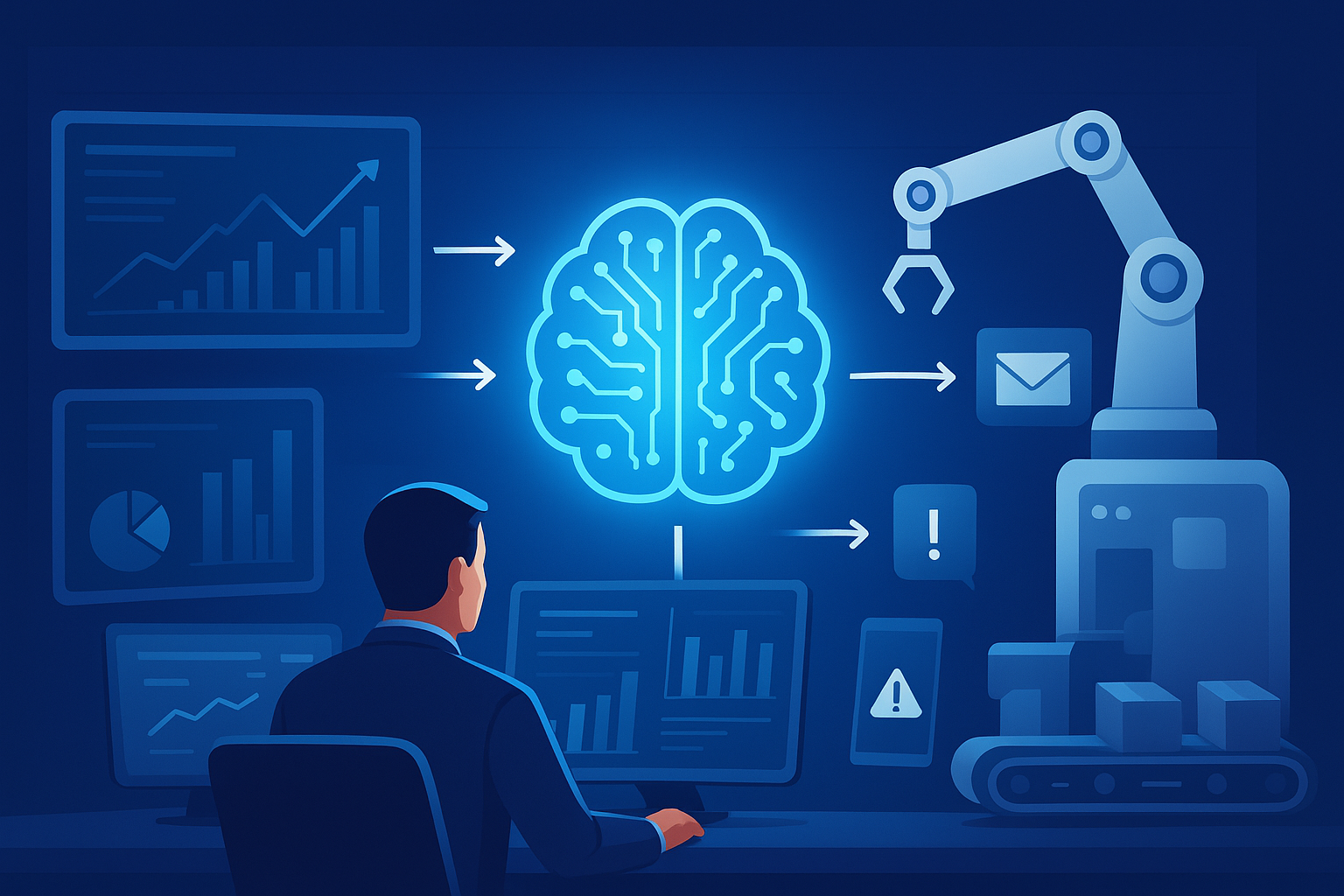
For decades, enterprises have invested heavily in business intelligence (BI) platforms, data lakes, and analytics teams. The promise has been simple yet ambitious: collect every data point, distill it into actionable insights, and give leaders the information they need to steer the business forward.
But here’s the uncomfortable truth in many organizations, those “actionable” insights rarely translate into actual action fast enough. Reports gather dust in shared drives. Dashboards are checked once a week. Insights come in after the moment to act has passed.
In other words, we’ve built incredible data-observation machines but not enough data-action machines. The real competitive advantage now lies in closing the data gap between when an insight is generated and when it drives a real-world change.And this is where AI that doesn’t just analyze but triggers automated workflows is transforming the game. By turning analytics into immediate execution, enterprises can go from seeing the problem to solving it in seconds.
Why the Data Gap Persists
Even with modern analytics stacks think Snowflake, Databricks, Tableau, Power BI the path from insight to execution remains stubbornly manual in most organizations.
Let’s break down the typical sequence:
- Data Collection: Metrics are gathered across CRM systems, ERP platforms, IoT devices, and digital channels.
- Analysis: Analysts query the data and produce a dashboard or report.
- Interpretation: Business stakeholders review the findings in meetings or via email.
- Decision: A manager decides on an action plan.
- Execution: Operational teams implement the decision, often involving additional coordination, approvals, and communication.
Even in high-functioning organizations, this pipeline can take days or weeks far longer than the window of opportunity in today’s markets.The root problem? The analysis layer and the execution layer are siloed. Your analytics system knows what to do, but your operational systems can’t automatically do it.
The Shift: From Insights to Automated Actions
The next evolution of enterprise data strategy is embedding decision-making and execution logic directly into the analytics layer.
This doesn’t mean replacing human judgment entirely. It means using AI to handle the 80% of operational responses that are repetitive, rule-based, and time-sensitive while surfacing the truly novel scenarios for human review.
Key capabilities enabling this shift include:
- Event-driven triggers: AI models that watch for threshold breaches, anomalies, or patterns in real time.
- Automated playbooks: Predefined workflows that are executed automatically when triggers occur.
- Integrated APIs: Seamless connections between analytics platforms and operational systems (CRM, ERP, marketing automation, supply chain, etc.).
Human-in-the-loop controls: Review checkpoints for high-risk or strategic decisions, ensuring governance without slowing the process unnecessarily.
Example: Sales Pipeline Acceleration
Let’s take a common use case sales operations.
Traditional approach:
- BI dashboard shows that a specific territory’s lead-to-close rate is dropping.
- Sales managers spot the trend in a Monday meeting.
- They email reps to follow up with high-value leads.
- Reps prioritize when they get to it.
AI-driven, action-oriented approach:
- AI model detects the dip in lead conversion in near real time.
- Automated workflow triggers a personalized follow-up sequence for high-probability leads in that territory.
- Sales reps receive notifications in their CRM with pre-drafted messages, ready to approve and send.
- Leads are re-engaged within hours, not days.
The shift is subtle but profound: decisions aren’t just faster they’re embedded in the system itself.
Why AI is the Missing Link
Analytics tools have always been able to detect patterns. The bottleneck has been operational execution. AI closes that gap in three ways:
- Contextual understanding: AI can analyze both structured and unstructured data from ERP transactions to support tickets providing richer triggers for action.
- Decision logic at scale: AI models can apply complex rules, business logic, and historical learnings instantly, deciding the best course of action without manual intervention.
Natural language and workflow integration: AI can interact with APIs, send emails, create Jira tickets, update CRMs, or even control physical systems, turning analysis into execution instantly.
Architecture for Closing the Data Gap
Implementing AI-triggered workflows requires a deliberate architecture that combines real-time analytics, decision models, and automation orchestration.
A reference architecture might look like this:
- Data ingestion layer: Streaming data from enterprise systems, IoT devices, and external APIs.
- Processing and analytics layer: A cloud data warehouse or lakehouse (e.g., Snowflake, Databricks) running both scheduled and continuous queries.
- Decision intelligence layer: AI/ML models that interpret analytics results, detect anomalies, and match conditions to predefined playbooks.
Automation layer: Workflow orchestration tools (e.g., Airflow, n8n, Workato, UiPath) that carry out the actions through API calls, RPA, or native integrations.
Feedback loop: Capturing results of each automated action to retrain models and refine triggers.
Governance is critical here every automation must be auditable, reversible, and aligned with enterprise policies.
Key Implementation Challenges
While the vision is compelling, decision-makers must plan for several hurdles:
- Data quality and latency: Poor or stale data will lead to poor automated decisions. Real-time or near-real-time feeds are non-negotiable for many use cases.
- Workflow complexity: Not every operational process is easily automated. Start with well-defined, repetitive workflows.
- Change management: Moving from “insight delivery” to “action execution” changes how teams work. Training, transparency, and clear escalation paths are essential.
- Security and compliance: Automated actions can have significant business impact robust permissions, approvals, and audit trails are a must.
High-Value Use Cases Across Industries
The insights-to-actions paradigm is industry-agnostic. Examples include:
- Manufacturing: Detecting quality issues on the production line and automatically adjusting machine settings or halting the line.
- Retail: Monitoring inventory levels and auto-reordering stock when thresholds are hit, factoring in real-time demand forecasts.
- Finance: Flagging fraudulent transactions and instantly freezing accounts or alerting compliance teams.
- Healthcare: Identifying patient risk indicators and triggering automated outreach for preventive care.
- Energy: Predicting equipment failure and scheduling immediate maintenance dispatch.
In each case, the competitive advantage comes from collapsing the time between knowing and doing.
Measuring Success
To evaluate the impact of closing the data gap, focus on metrics like:
- Decision latency: Time from insight detection to action execution.
- Operational throughput: Number of tasks handled automatically vs. manually.
- Accuracy of automated actions: Percentage of correct vs. overridden actions.
- Business outcome impact: Revenue lift, cost savings, or risk reduction directly attributable to automated actions.
A well-implemented insights-to-actions pipeline can reduce decision latency from days to minutes, with measurable ROI in both efficiency and agility.
A Gradual, Not Instant, Transformation
It’s tempting to imagine a fully autonomous enterprise where AI runs everything. In reality, most organizations will progress in stages:
- Augmented decision-making: AI surfaces recommendations alongside insights for human approval.
- Partial automation: Low-risk actions are triggered automatically; high-risk actions require review.
- Full automation with governance: High confidence, high-value workflows run without intervention, with ongoing monitoring and fallback mechanisms.
This staged approach builds trust, manages risk, and allows teams to adapt to the new operating model.
Why This Matters Now
Market cycles are faster. Supply chains are more volatile. Customer expectations shift in days, not quarters.
Enterprises that can move from seeing a change to responding to it instantly will outperform those that linger in the analysis phase. The old adage “knowledge is power” needs an update: “Execution speed is power.”
And the technology to make this happen from AI models to automation frameworks is mature, accessible, and increasingly affordable. What’s missing in many organizations is the connective tissue between analytics and action.
How Punctuations Helps You Close the Gap
At Punctuations, we specialize in building AI-powered automation layers that integrate directly with your analytics systems. We don’t just help you see what’s happening in your business we help you act on it instantly.
Our approach combines:
- Custom AI models trained on your proprietary data for precise, context-aware decisions.
- Seamless workflow automation connecting your BI tools to your operational systems.
- Human-in-the-loop governance so every automated action is safe, compliant, and auditable.
- Real-time monitoring dashboards to measure impact and continuously optimize performance.
If your enterprise is ready to turn insights into actions and collapse the lag between “knowing” and “doing,” let’s talk. We’ll help you design and implement a solution that delivers measurable ROI, operational resilience, and a lasting competitive edge.
Turn your analytics into action today. Book a consultation with Punctuations to explore how AI-driven workflows can collapse your decision-to-execution time from days to minutes.