In the executive suite and the boardroom, “Artificial Intelligence” has evolved from a futuristic buzzword into a present-day strategic imperative. The conversation is no longer if a business should adopt AI, but where and how to deploy it for maximum impact. Yet, amidst the hype, many leaders are left asking fundamental questions: How is AI being used today, really? What are some concrete examples of artificial intelligence that deliver tangible ROI? And most importantly, what can I do with artificial intelligence to gain a competitive edge?
This guide is for you. It cuts through the noise to provide a clear, practical overview of the applications of artificial intelligence that are transforming industries. We’ll explore where AI is used, what AI tools are available, and how you can begin leveraging these powerful technologies to optimize your operations, supercharge your marketing, and redefine your customer experience.
Demystifying the Engine: AI, ML, and Generative AI
Before we dive into specific examples, let’s briefly clarify the technology. Think of Artificial Intelligence (AI) as the broad science of making machines smart. Within AI, there is Machine Learning (ML), which is the engine that powers most modern AI applications. ML algorithms are trained on vast amounts of data to recognize patterns, make predictions, and “learn” without being explicitly programmed for every single task. This is the core of many applications of ML, from forecasting sales trends to identifying fraudulent transactions.The newest star is Generative AI, a subset of ML that can create new, original content text, images, code, and more. While traditional ML is excellent at analysis and prediction, Generative AI excels at creation, opening up a new frontier of possibilities. Understanding these distinctions is key to identifying which artificial intelligence products or software are right for your specific business needs.
Four Practical Applications of AI Reshaping Business Today
So, where is artificial intelligence used most effectively? While the use cases are vast, here are four practical applications of AI that are delivering significant value for medium and large businesses right now.
1. Revolutionizing Customer Engagement: The Rise of Intelligent Chatbot Customer Service
The days of clunky, frustrating chatbots that only understood “Press 1 for sales” are over. Modern chatbot customer service is powered by sophisticated AI that understands natural language, discerns user intent, and accesses vast knowledge bases to provide instant, accurate support.
- Where is AI used here? These AI systems are integrated into websites, mobile apps, and messaging platforms like WhatsApp and Messenger. They can handle a high volume of routine queries like order status, password resets, or product information 24/7, without human intervention.
- Examples of the use of artificial intelligence in this domain: A leading e-commerce brand uses an AI chatbot to instantly answer 70% of incoming customer queries, freeing up human agents to handle complex, high-value interactions. This not only cuts operational costs but also boosts customer satisfaction by eliminating wait times. Advanced AI can even detect customer frustration in the text and proactively escalate the conversation to a human agent, ensuring a seamless experience. The most popular AI apps for this include platforms like Intercom, Zendesk AI, and Ada, which provide robust artificial intelligence software designed for customer support.
2. Supercharging Growth: The Impact of Generative AI and Marketing
Marketing has become one of the most fertile grounds for AI innovation, particularly with the advent of generative models. The combination of generative AI and marketing allows teams to achieve a level of personalization, speed, and scale that was previously unimaginable.
- What can artificial intelligence be used for in marketing?
- Content Creation: Generate high-quality first drafts for blog posts, social media updates, email newsletters, and product descriptions in minutes, not hours.
- Ad Copy Optimization: Create and A/B test hundreds of variations of ad headlines and copy to find the most effective messaging for different audience segments.
- Hyper-Personalization: Analyze customer data to generate personalized email campaigns, product recommendations, and website content that speaks directly to each individual’s preferences and behaviour.
- Market Research: Quickly summarize long-form market reports, analyze competitor strategies from public data, and identify emerging consumer trends.
- AI Applications Examples: A global consumer goods company uses generative AI to create localized marketing campaigns for dozens of different regions, adapting messaging and imagery to cultural nuances automatically. This is a prime example of where AI is used today to bridge global scale with local relevance. Different AI tools like Jasper, Copy.ai, and Adobe Firefly are leading the charge, while larger platforms like HubSpot and Salesforce are embedding these capabilities directly into their marketing automation workflows.
3. Optimizing the Core: Intelligent AI Workflows and Operations
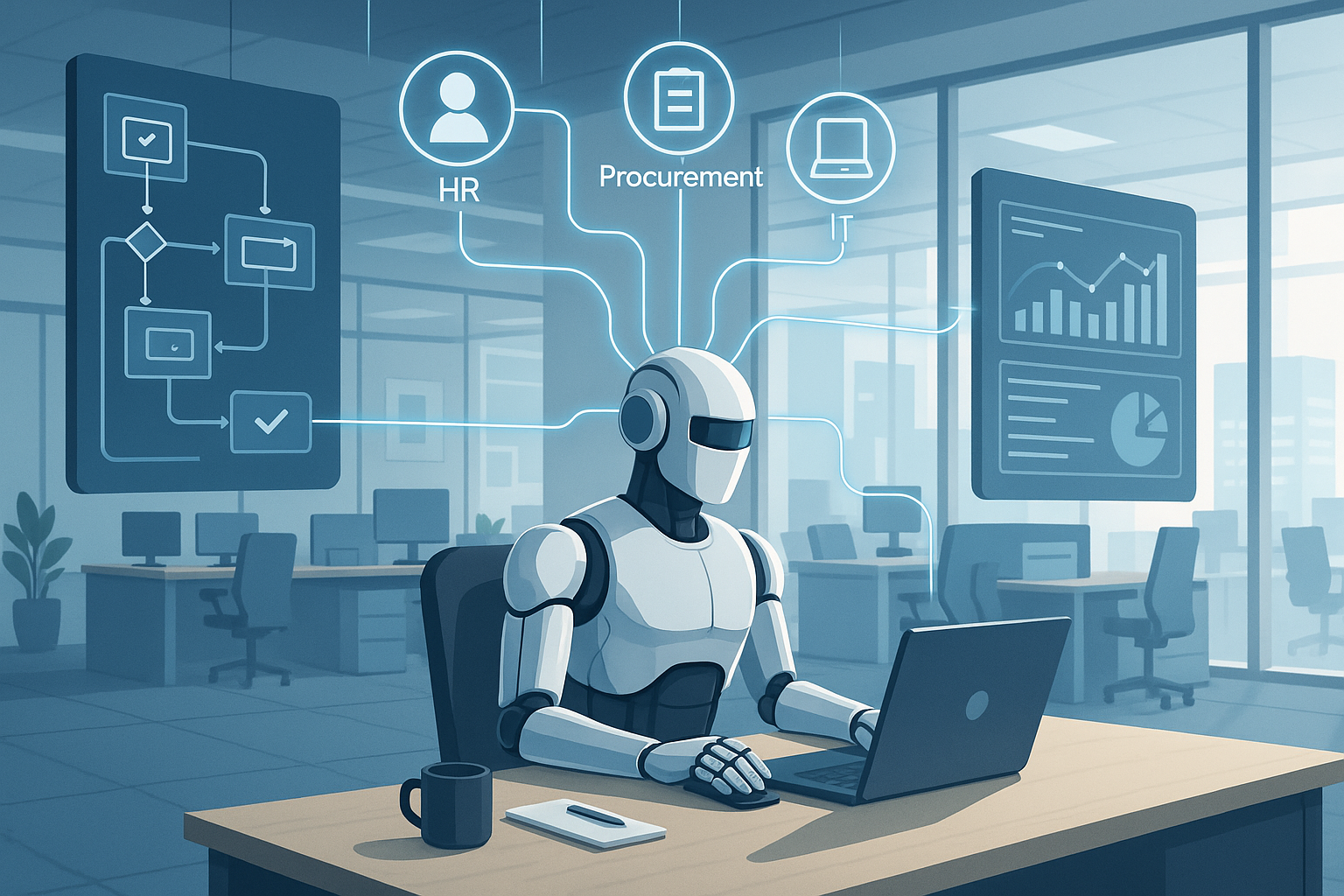
Some of the most powerful applications of artificial intelligence are not customer-facing but are instead focused on streamlining internal processes. AI workflows automate and optimize complex business operations, driving efficiency and reducing errors.
- How is AI being used today in operations?
- Supply Chain Management: ML models predict demand with greater accuracy, optimize inventory levels to reduce carrying costs, and identify the most efficient shipping routes in real-time.
- Predictive Maintenance: In manufacturing and logistics, AI analyzes data from sensors on machinery to predict when a part is likely to fail. This allows for proactive maintenance, preventing costly downtime.
- Financial Fraud Detection: Banks and financial institutions use AI to analyze millions of transactions in real-time, flagging suspicious activity with a precision that far surpasses human capabilities.
- Intelligent Document Processing (IDP): AI can read, understand, and extract key information from unstructured documents like invoices, contracts, and resumes, automating data entry and accelerating processes like accounts payable and recruitment.
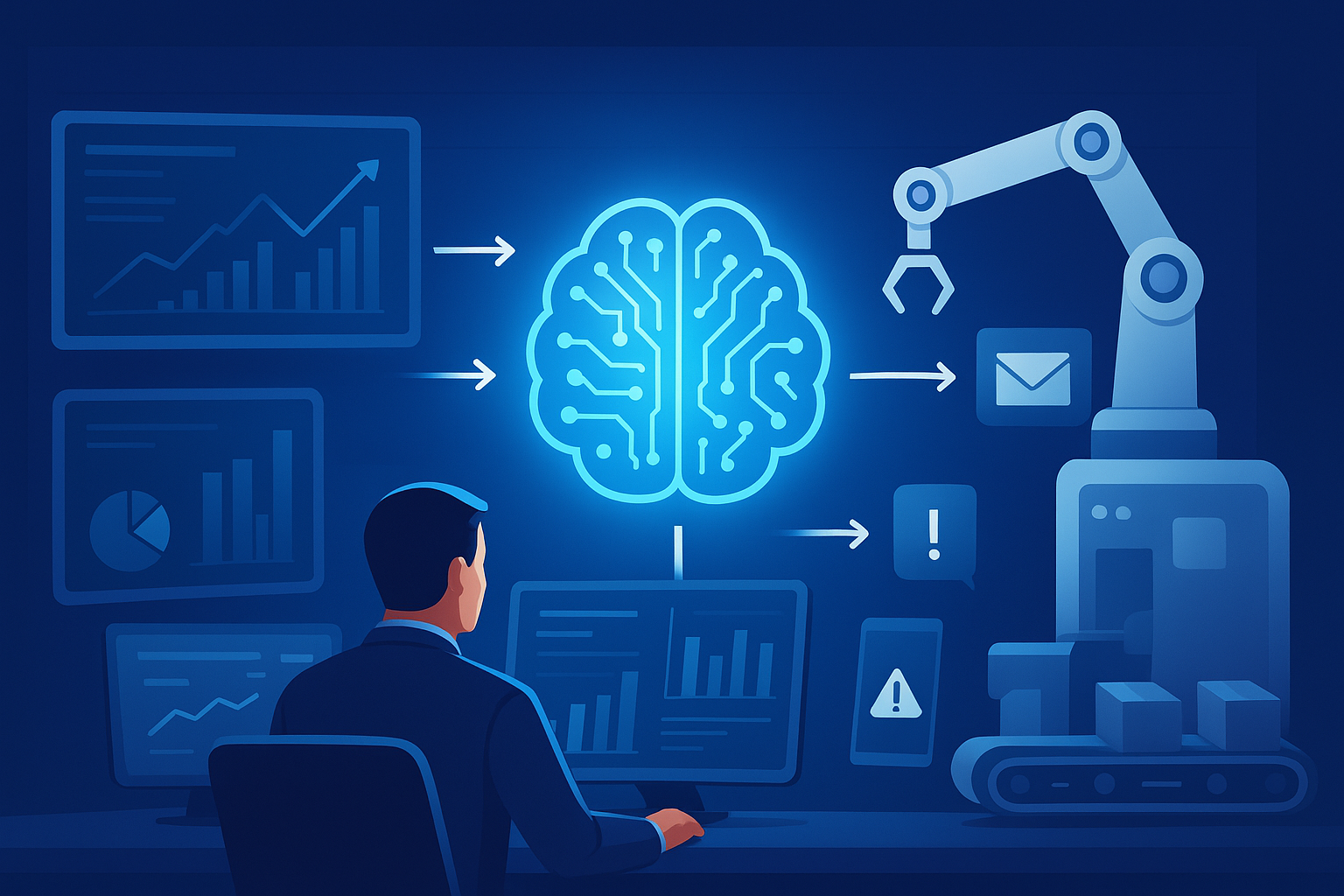
- These are powerful examples of AI that demonstrate its ability to be the central nervous system of a modern enterprise. Artificial intelligence products from companies like SAP, Oracle, and Microsoft are integrating these features directly into their ERP and business management software.
4. Unlocking Insights: Advanced Data Analysis
Every modern business generates a deluge of data. The challenge is turning that data into actionable insight. This is where applications of ML truly shine, going beyond simple dashboards to uncover deep, predictive insights.
- What can I do with artificial intelligence for data analysis? You can move from reactive to proactive decision-making. Instead of just knowing what happened, you can understand why it happened and predict what will happen next.
- AI Software Examples: Tools like Tableau (with its Einstein Discovery integration), Power BI, and specialized platforms like DataRobot allow business analysts to build sophisticated ML models without writing a single line of code. You can use these to predict customer churn, identify your most valuable customer segments, or forecast revenue with unprecedented accuracy. This is a clear answer to “what are AI tools?” they are instruments for converting raw data into strategic intelligence.
The Future is Now, But the Horizon is Expanding
While the applications above are available today, the future AI applications promise even more profound transformations. Imagine fully autonomous supply chains that self-correct based on global events, AI-driven product design that generates and tests thousands of prototypes virtually, or hyper-personalized healthcare plans based on your unique genetic makeup and lifestyle data. The AI of tomorrow will be more integrated, more autonomous, and more creative, making it an even more essential partner in business innovation.
Your Next Step on the AI Journey
The question is no longer “Where is artificial intelligence used?” but “Where will we use it first?” The sheer number of different AI tools and artificial intelligence software solutions can be overwhelming. Starting the journey requires a clear strategy identifying the business problem first, then finding the right technology to solve it. It’s about finding the intersection of high business value and data readiness.
Navigating this complex landscape requires a partner with both technical expertise and deep business acumen. At Punctuations, we specialize in helping businesses like yours demystify AI. We work with you to identify high-impact use cases, develop a data strategy, and implement the right artificial intelligence software to achieve your specific goals. Whether it’s enhancing your chatbot customer service, launching a generative AI marketing initiative, or streamlining your core operations with intelligent AI workflows, we provide the clarity and execution needed to turn AI potential into tangible business results.
Get in touch with us today to explore how we can help you build your future, one intelligent application at a time.