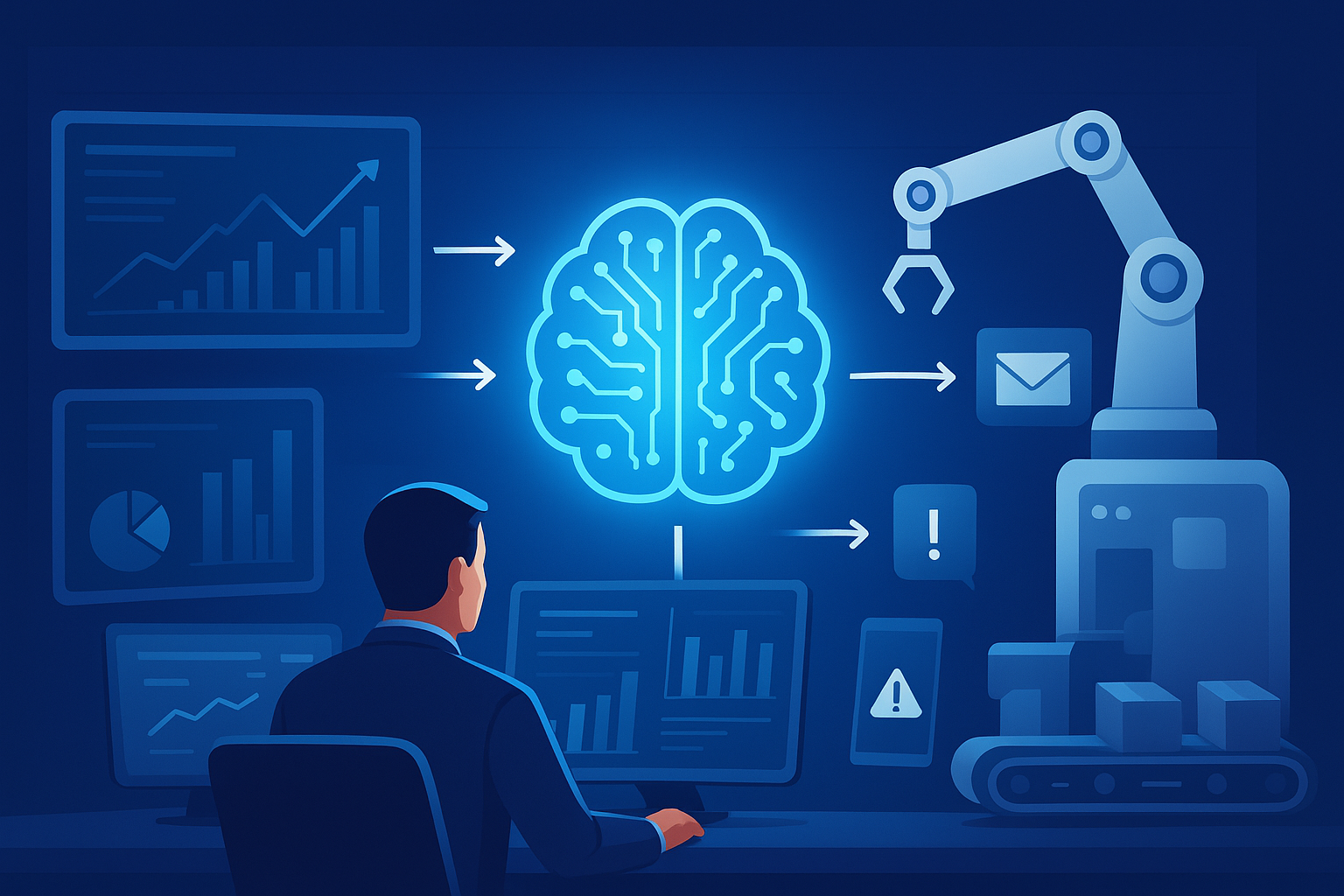
The conversation around artificial intelligence is about to shift. For the past few years, generative AI has captured the world’s imagination, dazzling us with its ability to create text, images, and code on command. It’s like having a brilliant, infinitely knowledgeable intern. But what if that intern could not only draft the report but also gather the data, schedule the meetings, email the stakeholders, and update the project management software, all on their own? That’s the paradigm shift promised by agentic AI, and it’s poised to be the defining technology trend for enterprise in 2025. This isn’t just another incremental update to existing AI models; it’s a fundamental leap from passive generation to proactive execution. As we look toward the next wave of AI adoption 2025, businesses that understand and pilot AI-powered agents will gain an unprecedented competitive advantage. This post will explore what agentic AI is, why the world’s leading companies are already investing in it, its transformative use cases, and the risks to consider.
What Exactly Is Agentic AI?
At its core, agentic AI is a system that can proactively take steps to achieve a goal with minimal human intervention. Unlike a standard chatbot or generative AI model which waits for a prompt and provides a single, self-contained response, an AI agent can perform a sequence of actions. It can plan, use tools, remember past interactions, and adapt its strategy to achieve a complex objective.
Think of it this way:
- Traditional Automation (RPA): Follows a rigid, pre-programmed script. If Step 3 fails, the whole process breaks. It’s a train on a track.
- Generative AI (e.g., ChatGPT): A powerful reasoning and content creation engine. You can ask it to write an email, but you still have to copy, paste, and send it yourself. It’s a calculator for words and ideas.
- Agentic AI: A goal-oriented system. You give it an objective, like “Find the top three catering vendors in Mumbai for our upcoming 200-person event, get quotes, and summarize them in a spreadsheet by Friday.” The agent then autonomously executes the necessary tasks: searching the web, visiting vendor websites, interacting with chatbots or filling out contact forms, parsing the returned quotes, and compiling the final report. It’s a project manager.
The key capability that unlocks this is multistep reasoning. An agentic system can break down a high-level goal into a logical chain of sub-tasks. It can decide to use a search engine, then access an API, then run some code, then draft an email all as part of a single, fluid autonomous workflow
Why Fortune 500s Are Aggressively Piloting AI Agents
The C-suites of the world’s largest companies aren’t just experimenting with agentic AI for the novelty; they are driven by the pursuit of tangible AI ROI and a strategic imperative to redefine productivity. While generative AI has shown promising results, a 2024 study from MIT CSAIL noted that it boosted productivity by an average of 40% on specific writing tasks. Leaders are now asking: how can we apply that level of impact to entire business processes?
The answer lies in agentic AI. Here’s why it’s gaining traction:
- Unlocking True Enterprise Automation: Current automation is brittle. Agentic AI offers dynamic, resilient automation. It can navigate unexpected errors, adapt to changes in user interfaces, and make decisions to keep a process moving. This is the next frontier of enterprise automation, moving beyond simple tasks to orchestrating complex, cross-functional operations.
- Elevating Human Capital to High-Value Tasks: The true measure of AI productivity isn’t just about doing the same work faster; it’s about fundamentally changing the work humans do. A recent report by McKinsey estimates that generative AI (including agentic systems) could automate activities that absorb 60 to 70 percent of employees’ time. By delegating complex, time-consuming coordination and research tasks to AI-powered agents, employees are freed to focus on strategy, creative problem-solving, and building client relationships the high-value tasks that drive innovation and growth.
- Achieving Compounding AI ROI: The return on investment for an AI agent isn’t linear. An agent designed for sales prospecting, for example, not only saves time but also improves lead quality, shortens sales cycles, and increases conversion rates. This creates a compounding effect on revenue. Similarly, an agent managing supply chain logistics can proactively prevent costly disruptions, delivering an AI ROI that far exceeds simple time savings.
Bridging the Data-to-Action Gap: Enterprises are drowning in data but starving for action. An AI agent can act as the bridge. It can monitor real-time data streams (like customer feedback or market trends), interpret the information using its reasoning engine, and immediately trigger the appropriate business process AI workflow whether it’s creating a support ticket, alerting a product manager, or adjusting a marketing budget.
Three Industry Use-Cases Revolutionized by Agentic AI
The theoretical promise of agentic AI becomes concrete when we examine its application in specific industries. Here are three examples of how these systems will reshape workflows in 2025.
1. Supply Chain and Logistics: The Proactive Disruption Manager
The Goal: Ensure on-time delivery of critical components despite global volatility.
The Agentic Workflow: An AI-powered agent, let’s call it “LogiBot,” is tasked with monitoring a company’s key shipping lanes.
- Sensing: The agent continuously scans news feeds, weather reports, port authority websites, and social media for potential disruptions like strikes, severe storms, or geopolitical tensions.
- Reasoning: It detects news of a sudden port closure in Singapore that will impact a critical shipment. Using multistep reasoning, it determines the shipment’s value, the downstream production impact, and the available alternatives.
- Acting: The agent autonomously executes a plan:
- It queries internal systems to identify all containers affected.
- It accesses API data from alternative carriers to find new routes via air or a different seaport.
- It calculates the cost and time trade-offs for each option.
- It initiates a booking with the optimal new carrier and sends a notification with a summary and recommendation to a human manager for final approval.
- Once approved, it updates the ERP and inventory management systems with the new ETA.
This autonomous workflow turns a reactive, multi-day crisis management scramble into a proactive, hours-long automated response, saving millions in potential losses.
2. Financial Services: The Tireless Research Analyst
The Goal: Accelerate equity research and identify investment opportunities faster.
The Agentic Workflow: A human analyst gives an agent the objective: “Generate a preliminary report on Company Y’s competitive position in the cloud computing market following their latest earnings call.”
- Planning: The agent breaks the goal down: fetch the earnings report and transcript, analyze key financial metrics, identify top competitors, gather recent news and analyst ratings for all companies, and synthesize the findings.
- Tool Use: The agent executes the plan:
- It accesses SEC Edgar to download the 10-Q filing.
- It connects to a financial data API (like Bloomberg or Refinitiv) to pull stock performance and valuation metrics.
- It performs targeted web searches to gather news articles and competitor announcements.
- It scrapes sentiment analysis from financial social media.
- Synthesis: Using its language model capabilities, the agent drafts a structured report complete with charts, key takeaways, a SWOT analysis, and a list of unanswered questions for the human analyst to investigate further.
This frees the human analyst from dozens of hours of data collection, allowing them to focus on the truly high-value tasks of nuanced interpretation and strategic decision-making, drastically improving AI productivity in the finance sector.
3. Marketing and Sales: The Hyper-Personalization Engine
The Goal: Increase qualified leads from a target industry segment by 20%.
The Agentic Workflow: A marketing manager tasks a sales agent with a high-level goal.
- Prospecting: The agent accesses LinkedIn Sales Navigator and the company’s CRM to identify hundreds of potential leads that fit the ideal customer profile.
- Researching: For each high-priority lead, the agent conducts automated research, visiting their company website, reading their recent blog posts, and identifying their role-specific pain points.
- Personalizing & Engaging: The agent drafts a unique, hyper-personalized email for each lead, referencing their specific company initiatives or recent work. It then schedules the emails to be sent through the company’s outreach platform.
- Managing & Nurturing: The agent monitors replies. For positive responses, it can schedule a meeting directly on the sales representative’s calendar. For neutral or negative responses, it can schedule a polite follow-up in a few weeks or mark them as “not interested” in the CRM.
This level of business process AI allows a small team to engage in personalized outreach at a scale that would normally require a massive sales development department, directly boosting pipeline and AI ROI.
Navigating the Risks of AI Agent Adoption
The journey toward AI adoption 2025 is not without its challenges. Implementing agentic AI is more complex than deploying a simple chatbot. Businesses must be clear-eyed about the risks:
- Security and Access Control: Agents need access to multiple systems and data sources to function. This creates a significant security challenge. A compromised agent could become a powerful tool for malicious actors. Robust identity and access management for AI agents is critical.
- Reliability and Hallucinations: What happens if an agent misunderstands a goal or “hallucinates” a fact, leading it to take an incorrect and costly action? Building “human-in-the-loop” approval points for critical decisions and rigorous testing protocols are essential to mitigate this risk.
- Integration Complexity: Most enterprises run on a complex patchwork of modern and legacy systems. Creating the “digital plumbing” (APIs and connectors) that allows an agent to seamlessly interact with all these tools is a major technical hurdle.
- Cost and Scalability: The multistep reasoning performed by advanced agents can be computationally expensive. Organizations must carefully evaluate the cost-benefit analysis and plan for scaling these workloads efficiently.
- Change Management and Trust: Employees may be resistant or fearful of working alongside autonomous systems. A successful implementation requires a clear communication strategy, robust training programs, and a focus on how agentic AI augments, rather than replaces, human expertise.
The Future of Work Is Agentic. Are You Ready?
The rise of agentic AI marks a pivotal moment in the evolution of enterprise automation. It promises to move us beyond simple task execution and into an era of fully autonomous, goal-driven workflows that will unlock unprecedented levels of productivity and innovation. The question is no longer if this technology will reshape industries, but when and who will lead the charge.
Navigating the transition from traditional processes to an agentic future requires more than just technology; it requires a strategic partner who understands the intersection of business process AI, organizational change, and technical implementation.
Unlock Your Agentic AI Potential with Punctuations
The path to harnessing the power of AI-powered agents is complex, but you don’t have to walk it alone. At Punctuations, we specialize in helping enterprises navigate the landscape of agentic AI, from strategic roadmapping and readiness assessments to pilot program design and full-scale implementation.
Our team of experts can help you identify high-impact use cases, mitigate adoption risks, and build a clear roadmap for achieving significant AI ROI.Ready to transform your enterprise workflows and prepare for 2025? Contact us today for a complimentary Agentic AI Readiness Assessment and discover what’s possible.
Contact Punctuations for Your Free Assessment