In 2025, most large organizations have already experimented with artificial intelligence in some capacity be it a chatbot in customer service, an AI-powered analytics dashboard, or a marketing automation tool. Yet, many of these initiatives remain siloed, handling isolated tasks without fundamentally reshaping the flow of work across the enterprise.
The next wave of adoption is being led by Agentic AI AI systems capable of operating as autonomous agents that plan, execute, and adapt across multi-step, cross-department workflows. Unlike traditional AI tools that require frequent human prompts, Agentic AI can independently coordinate between systems, stakeholders, and business rules, delivering measurable gains in efficiency, scalability, and operational consistency.This shift is not about replacing human judgment in strategic areas it’s about offloading high-friction, repetitive, and interdependent work from people to machine-driven agents that never tire, never forget, and never miss a step.
From Reactive AI to Proactive Agents
Historically, enterprise AI has been reactive:
- Predictive analytics forecasts demand, but humans still execute replenishment.
- Chatbots respond to queries, but escalate to humans for follow-up actions.
- Process automation (RPA) clicks through screens, but only in narrowly scripted scenarios.
Agentic AI changes this paradigm.
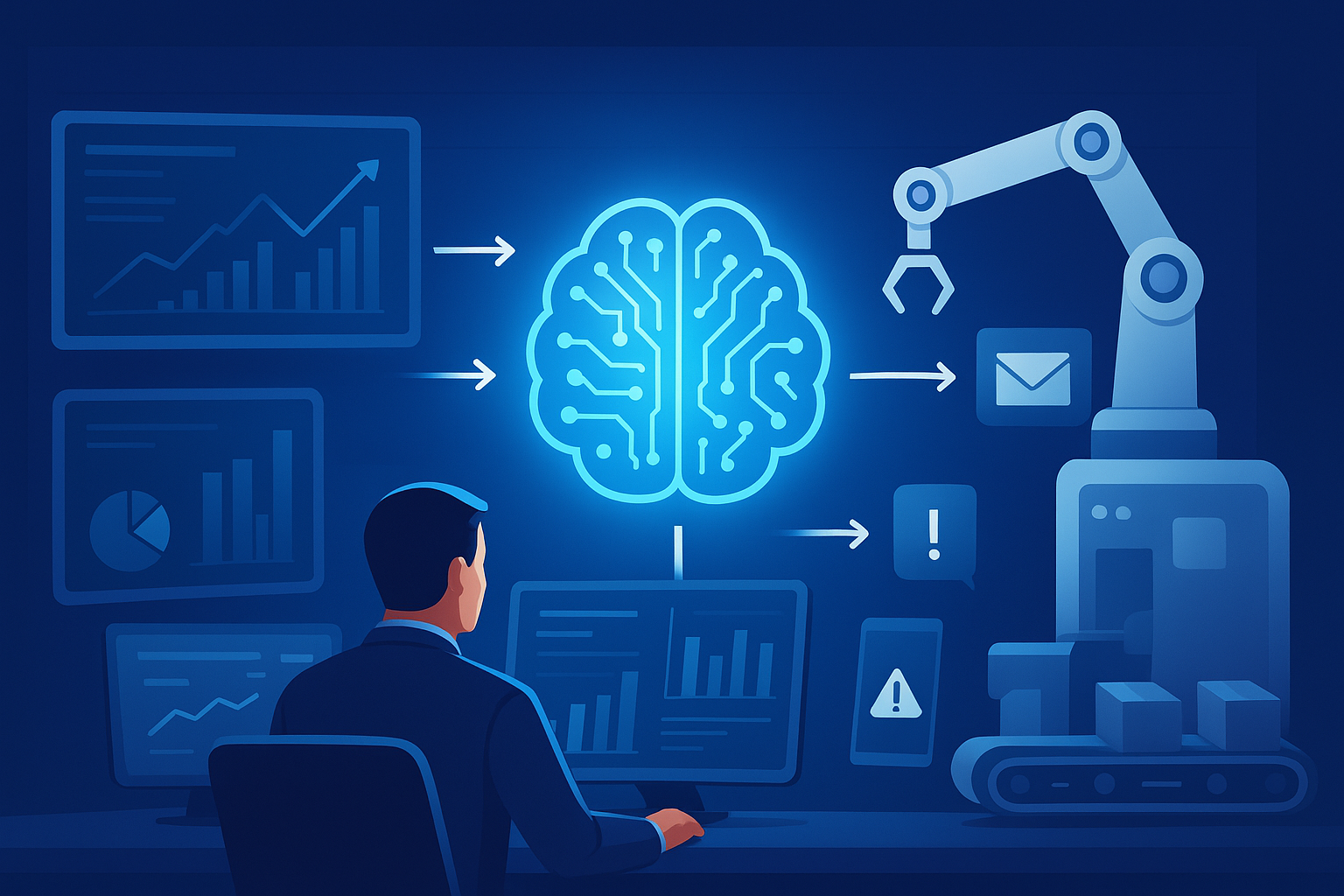
Instead of waiting for a prompt or a trigger, these agents maintain goal awareness and state awareness meaning they understand not just the task at hand, but also the overall business objective and the current context across multiple systems.
A procurement agent, for example, wouldn’t just submit a purchase order when stock levels fall below threshold it would:
- Check supplier performance and lead times from recent ERP data.
- Compare multiple vendor quotes fetched via integrated APIs.
- Run a budget impact analysis against current financial forecasts.
- Secure internal approval through integrated workflow tools.
- Submit the order, track fulfillment, and escalate if delays are predicted.
The human role shifts from “operator” to “supervisor,” focusing on exception handling and strategic decision-making.
Core Capabilities of Agentic AI in Enterprise Workflows
To understand why this is different from conventional AI automation, it’s important to unpack the technical building blocks that make autonomous operation possible:
1. Multi-Step Planning and Execution
Agentic AI uses task-planning frameworks (like Planning Domain Definition Language or custom orchestration graphs) to map out an entire sequence of actions. This is different from standard workflow automation because the plan can change mid-execution if new information comes in.
2. Cross-System Integration
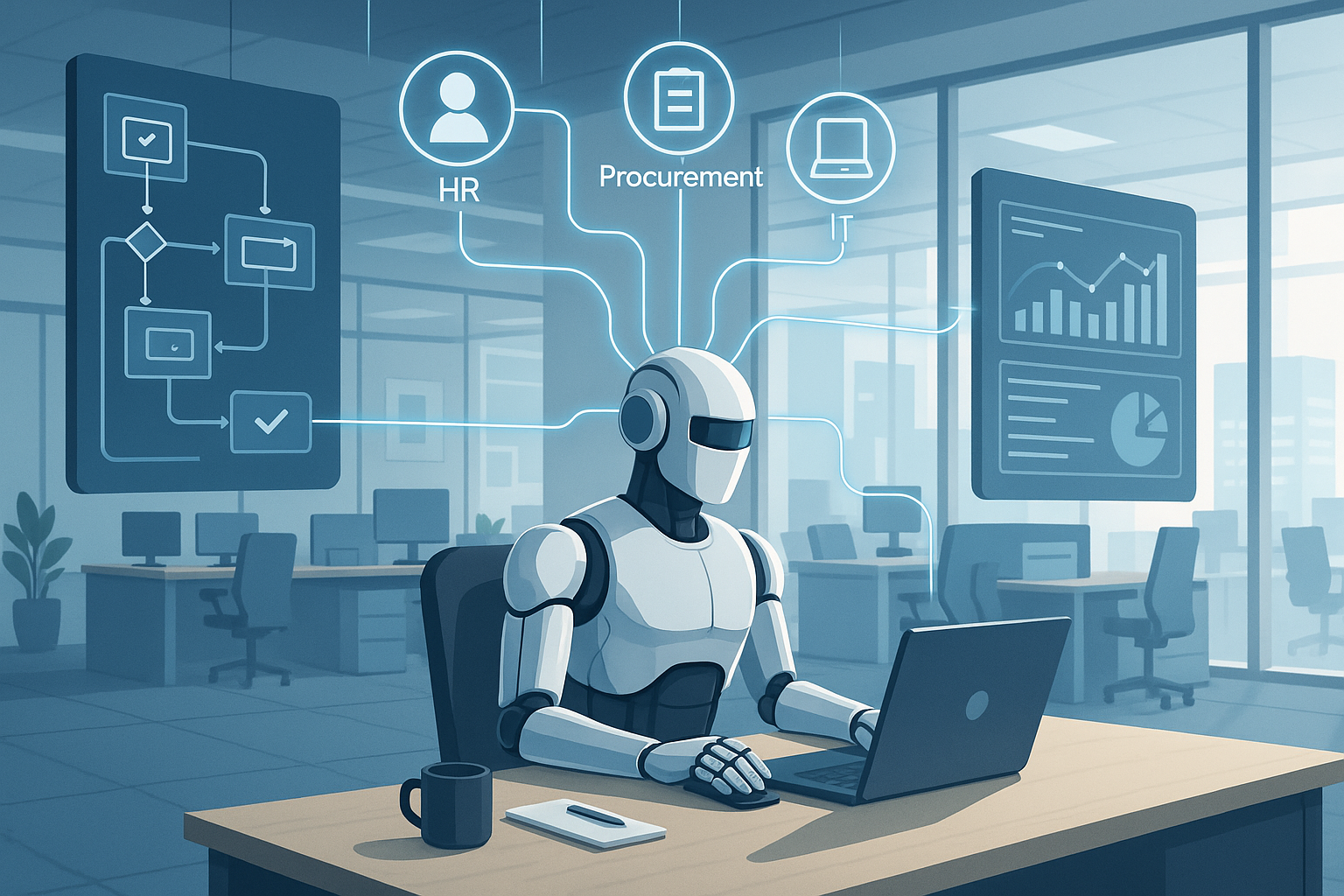
These agents connect to CRMs, ERPs, HRIS, supply chain systems, and custom databases via secure APIs or middleware. The ability to read and write data across heterogeneous systems means they can coordinate processes that traditionally require multiple teams.
3. Continuous Context Awareness
An agent maintains a working “memory” of the task state what’s been done, what’s pending, and what’s changed in the environment allowing for dynamic decision-making instead of rigid, pre-coded scripts.
4. Autonomous Decision Policies
Through reinforcement learning or rules-based logic, agents select actions based on business priorities for example, preferring cost efficiency over speed in low-urgency cases, or escalating to human review if compliance risk is detected.
5. Natural Language Interaction
Even though they operate autonomously, agents often use natural language to explain decisions, request clarifications, or summarize progress making them accessible to non-technical stakeholders.
Enterprise Use Cases: From Theory to Practice
The potential applications span nearly every industry and function. Here are a few scenarios where Agentic AI in enterprise workflows is already delivering impact.
1. Cross-Department Onboarding
When a new employee joins a multinational, onboarding typically spans HR, IT, Facilities, and Finance:
- HR verifies documentation.
- IT provisions accounts and devices.
- Facilities arrange seating and access badges.
- Finance sets up payroll and expense accounts.
A single Agentic AI system can orchestrate this process end-to-end:
- Pulling candidate data from the applicant tracking system.
- Scheduling mandatory training.
- Coordinating device shipping with IT.
- Triggering payroll setup.
- Confirming completion and sending welcome communications.
Impact: Reduces manual coordination, cuts onboarding time by 50–70%, and ensures no compliance step is skipped.
2. Automated Compliance Monitoring
In heavily regulated sectors like banking or pharmaceuticals, compliance checks often span multiple data sources and require repetitive reporting:
- Data is pulled from transactional systems.
- Activities are compared against regulatory thresholds.
- Exceptions are flagged and logged.
- Reports are compiled and submitted to regulators.
An Agentic AI compliance agent can continuously monitor transactions in real-time, initiate investigations, and automatically generate regulator-ready reports while maintaining a full audit trail.
Impact: Reduces compliance reporting cycles from weeks to hours, while improving accuracy and traceability.
3. Proactive Supply Chain Management
In manufacturing, supply chain teams deal with fluctuating demand, vendor delays, and logistics bottlenecks:
- Forecasts change due to market signals.
- Suppliers have variable lead times.
- Shipments may be delayed at customs.
An AI supply chain agent can:
- Detect early warning signals from IoT sensor data and ERP feeds.
- Recalculate production schedules.
- Automatically place backup orders with secondary suppliers.
- Inform sales teams about updated delivery timelines.
Impact: Mitigates downtime risk, keeps customers informed, and reduces expedite shipping costs.
4. Cross-Platform Customer Case Resolution
Customer service tickets often require CRM data, technical logs, billing records, and inventory updates:
- A refund request may involve checking usage logs and stock availability.
- A warranty claim might need verification from product QA teams.
An Agentic AI service agent can automatically pull, cross-verify, and act across all systems initiating refunds, triggering product replacements, and sending status updates without a single email chain.
Impact: Cuts resolution time from days to minutes, improving customer satisfaction scores and reducing agent workload.
Key Benefits for Decision Makers
1. Significant Efficiency Gains
By offloading repetitive, multi-step tasks, organizations can redeploy human talent to higher-value activities.Example: A global logistics company reduced manual scheduling work by 80%, freeing planners for strategic route optimization.
2. Enhanced Accuracy and Compliance
Agents never “forget” a step, skip a check, or misapply a rule leading to better data quality and lower compliance risk.
3. Scalability Without Linear Headcount Growth
Because Agentic AI operates 24/7 and handles multiple workflows in parallel, scaling output doesn’t require proportional increases in staff.
4. Faster Response to Business Changes
Agents can instantly adapt to changing inputs—market shifts, new regulations, or system updates without lengthy retraining or re-coding.
5. Data-Driven Continuous Improvement
Agents log every action, decision point, and outcome, creating a feedback loop for ongoing optimization and strategic insights.
Challenges and Considerations
Before rushing into implementation, decision makers should be aware of the operational and governance challenges:
1. Data Silos and Integration Complexity
The more disconnected your systems, the harder it is for an agent to operate effectively. API maturity and clean data pipelines are prerequisites.
2. Governance and Accountability
Autonomous agents still need clear oversight models. Define escalation thresholds, approval workflows, and audit logging.
3. Security and Compliance Risks
Since agents operate across multiple systems, access control and data protection must be robust especially when handling PII or regulated information.
4. Change Management
Employees may resist perceived “automation creep.” Position Agentic AI as a collaborative tool, not a replacement.
Implementation Roadmap for Enterprises
A successful Agentic AI deployment follows a structured path:
Step 1: Identify High-Friction, Cross-Functional Workflows
Focus on processes that:
- Span multiple departments.
- Are rules-driven but repetitive.
- Have measurable KPIs (time, cost, error rate).
Step 2: Map Systems and Data Flows
Document where data lives, how it’s accessed, and who owns it.
Step 3: Start with a Pilot Agent
Pick one high-impact workflow, build an agent to handle 60–80% of it autonomously, and keep humans in the loop for edge cases.
Step 4: Monitor and Optimize
Track agent performance against KPIs, refine rules, and expand coverage.
Step 5: Scale to Adjacent Workflows
Once proven, roll out to other processes with similar data access and decision logic.
The Future: Agent Networks, Not Just Single Agents
Looking ahead, the real power emerges when multiple agents collaborate each specialized in a domain but coordinating via a shared context layer.
Picture this:
- A Sales Agent closes a deal →
- Triggers a Project Delivery Agent to allocate resources →
- Which informs a Finance Agent to adjust cash flow forecasts →
- While a Compliance Agent monitors every step for regulatory adherence.
This ecosystem of autonomous agents creates an enterprise that is continuously self-optimizing with humans steering strategy and innovation.
How Punctuations Can Help
At Punctuations, we specialize in designing, training, and deploying Agentic AI systems tailored to your enterprise workflows. Our approach integrates:
- Custom agent orchestration for multi-step, cross-department processes.
- Secure system integration with your ERP, CRM, HRIS, and legacy tools.
- Governance frameworks for compliance, auditability, and human-in-the-loop controls.
- Continuous optimization loops based on real-world performance data.
Whether you’re looking to automate a single process or orchestrate a network of agents across your business, we’ll partner with you from roadmap to rollout ensuring you see measurable ROI without compromising security or compliance.
Ready to explore how Agentic AI can transform your enterprise workflows?
Get in touch with us today to start your pilot and unlock the next level of operational efficiency.